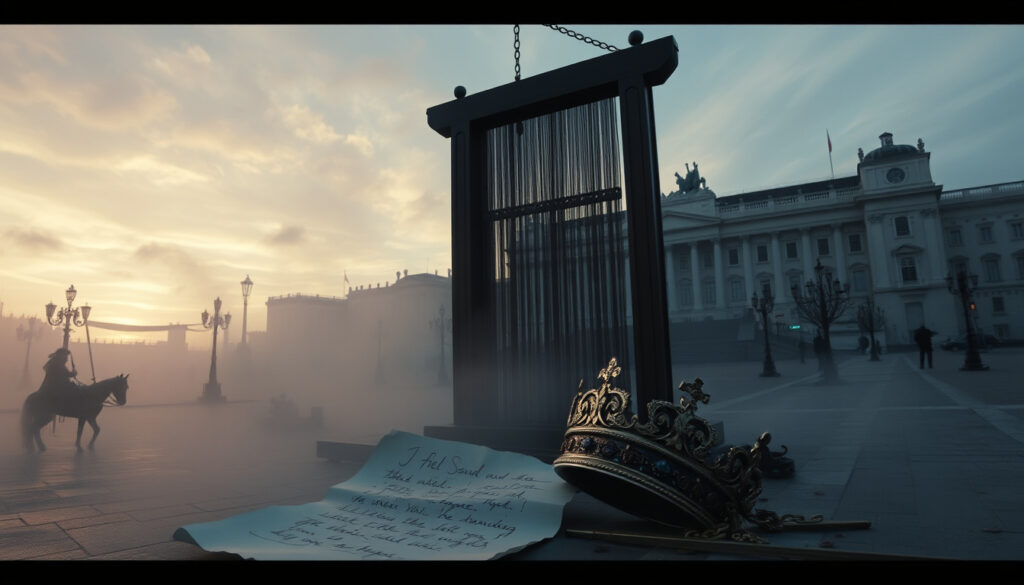
Louis XVI: Biography, Reign, Execution & Last Words
One moment Louis XVI was the absolute ruler of France, the wealthiest and most powerful man in the kingdom. The next, he was a prisoner awaiting death by guillotine.
Born: 23 August 1754 ·
Died: 21 January 1793 ·
Reign: 1774–1792 ·
Age at death: 38 ·
Spouse: Marie Antoinette ·
Cause of death: Guillotine execution
Quick snapshot
- Executed by guillotine on 21 January 1793 (Wikipedia (community encyclopedia))
- Condemned for treason by the National Convention (Britannica (historical encyclopedia))
- Age at death: 38 years (Biography.com (reference))
- Exact wording of his last words varies among contemporary accounts (Origins (Ohio State University) (university historical project))
- Whether Louis truly accepted the revolutionary government or secretly plotted is debated (Origins (Ohio State University) (university historical project))
- Some details of the marriage consummation issue remain speculative (Origins (Ohio State University) (university historical project))
- 21 January 1793: Louis XVI executed (Wikipedia (community encyclopedia))
- 16 October 1793: Marie Antoinette executed (Britannica (historical encyclopedia))
- 9 months between their deaths (History.com (history reference))
- After Louis’s execution, the Reign of Terror intensified (Wikipedia (community encyclopedia))
- Marie Antoinette was tried and executed nine months later (Wikipedia (community encyclopedia))
- Louis’s son, Louis XVII, died in captivity in 1795 (Britannica (historical encyclopedia))
Eight key facts about Louis XVI, one pattern: his downfall was driven by a cascade of political missteps that left him politically isolated by the time revolutionaries voted on his fate.
| Fact | Value |
|---|---|
| Full name | Louis Auguste de France |
| Born | 23 August 1754, Versailles, France |
| Died | 21 January 1793, Paris, France |
| Reign | 10 May 1774 – 21 September 1792 |
| Spouse | Marie Antoinette (m. 1770) |
| Children | Marie Thérèse, Louis Joseph, Louis XVII, Sophie |
| Dynasty | House of Bourbon |
| Cause of death | Execution by guillotine |
Why was Louis XVI condemned to death?
Louis XVI was not condemned for a single crime but for a pattern of resistance to revolutionary change. His trial was a political death sentence as much as a legal one.
What were the charges against Louis XVI?
- Treason against the state, conspiracy against the Republic, and plotting with foreign powers (Wikipedia (community encyclopedia))
- Specifically, his secret correspondence with Austria and Prussia and his attempted flight in June 1791 were cited as evidence (Wikipedia (community encyclopedia))
How was his trial conducted?
- Louis XVI was tried before the National Convention from 11 to 26 December 1792 (Wikipedia (community encyclopedia))
- He was allowed to defend himself but had no legal counsel of his choosing (History.com (history reference))
- The Convention acted as both prosecutor and judge (Wikipedia (community encyclopedia))
What was the outcome?
- The first decisive condemnation vote on 18 January 1793 was 387 votes to 334 on guilt and punishment-related questions (History.com (history reference))
- A further vote on 19 January 1793 condemned Louis XVI to death by 380 votes to 310 (Wikipedia (community encyclopedia))
- He was executed on 21 January 1793 at Place de la Révolution in Paris (Biography.com (reference))
The implication: Louis XVI’s fate was sealed not by one act but by a cumulative loss of political trust. His indecision before the Revolution — and his secret resistance after it — left revolutionaries with no incentive to spare him.
What were Louis XVI’s last words?
The king who had ruled by divine right ended his life with words of forgiveness — but history cannot agree on exactly what he said.
Did Louis XVI say anything on the scaffold?
- Yes, multiple witnesses recorded statements (Origins (Ohio State University) (university historical project))
- Accounts differ on the exact phrasing
What is the exact French quote?
- A widely cited version: “Gentlemen, I am innocent of everything of which I am accused. I hope that my blood may cement the good fortune of the French.” (Wikipedia (community encyclopedia))
- An alternate account from executioner Charles-Henri Sanson: “I die innocent. I pardon my enemies and I hope that my blood will be useful to the French…” before drums obscured his words (Origins (Ohio State University) (university historical project))
How were his last words recorded?
- Eyewitness accounts documented by Charles-Henri Sanson and others (Origins (Ohio State University) (university historical project))
- His words were deliberately drowned out by drum rolls after the first few sentences (Origins (Ohio State University) (university historical project))
The catch: The core of his message — innocence and forgiveness — is consistent across all accounts. The variations matter only to those seeking a single definitive quote.
Why was Louis XVI a bad king?
Louis XVI’s personal decency — he was known as a loving husband and father — became a political liability. His kindness made him indecisive at moments that required ruthlessness.
What were his key mistakes as ruler?
- Inherited massive debt from the Seven Years’ War and American Revolution support (Britannica (historical encyclopedia))
- Failed to implement fiscal reforms, leading to the Estates-General of 1789 (Britannica (historical encyclopedia))
- Attempted to flee the country in the Flight to Varennes (June 1791), undermining trust (Britannica (historical encyclopedia))
- Reluctantly accepted the Constitution of 1791 but covertly worked against it (Britannica (historical encyclopedia))
How did his personality affect his rule?
- Indecisive and easily influenced by advisors and his wife (Britannica (historical encyclopedia))
- Preferred hunting and lock-making to governance
- His shyness made it difficult for him to lead in person at critical moments
Did he have any successes?
- France’s support for the American Revolution was a strategic success, but it deepened the debt crisis (Britannica (historical encyclopedia))
- He was a devoted father to his children
- His reign saw the abolition of serfdom on royal estates and some progressive judicial reforms
Why this matters: The same indecisiveness that made him a gentle father made him a disastrous monarch. Revolutionary France needed a leader who could make hard choices; it got a king who could not choose at all.
How old was Louis XVI when he died?
Three dates define the arc of Louis XVI’s life, one pattern: his reign was cut short almost exactly halfway through what might have been a normal lifespan.
| Date | Event | Age |
|---|---|---|
| 23 August 1754 | Born at Versailles | 0 |
| 10 May 1774 | Became King after Louis XV’s death | 19 |
| 21 January 1793 | Executed by guillotine | 38 |
What was his date of birth?
- Born 23 August 1754 (Britannica (historical encyclopedia))
How many years did he reign?
- Reigned for 18 years, 4 months, and 11 days (Britannica (historical encyclopedia))
What was his age at accession?
- Became king at age 19 (10 May 1774) (Britannica (historical encyclopedia))
The pattern: Louis XVI died at roughly the same age as his great-grandfather Louis XIV had been alive for only half his reign. The contrast underscores how dramatically the political landscape had shifted.
Who died first, Louis or Marie Antoinette?
Louis died first, but Marie faced a far more public and humiliating trial. Their deaths were separated by the entire summer of the Terror.
When was Marie Antoinette executed?
- Marie Antoinette was executed on 16 October 1793 (Britannica (historical encyclopedia))
- She was brought before the Revolutionary Tribunal on 14 October 1793 and guillotined two days later (Britannica (historical encyclopedia))
What was the gap between their deaths?
- Louis XVI executed on 21 January 1793 (Wikipedia (community encyclopedia))
- Marie Antoinette executed on 16 October 1793 (Wikipedia (community encyclopedia))
- Louis died first, nine months before Marie
Why was she executed?
- Marie was tried and executed after the Reign of Terror intensified (Wikipedia (community encyclopedia))
- Both were accused of treason against the Republic (Britannica (historical encyclopedia))
- Marie’s trial included accusations of incest and financial crimes
The implication: The order of their deaths — Louis then Marie — shows how the Revolution escalated. The execution of the king opened the door for the execution of the queen, and eventually for the Reign of Terror that consumed thousands more.
“Louis must die so that the country may live.”
— Maximilien Robespierre, speech to the National Convention, 3 December 1792
“I am innocent of the crimes of which I am accused. I forgive the authors of my death. May my blood not fall upon France.”
— Louis XVI, on the scaffold, 21 January 1793 (attributed)
“Pardon me, sir, I did not do it on purpose.”
— Marie Antoinette, last words after stepping on the executioner’s foot, 16 October 1793 (attributed)
For anyone researching the French Revolution’s royal victims, the contrast between Louis XVI’s political downfall and Marie Antoinette’s personal tragedy is stark. Louis failed as a leader; Marie failed as a symbol. Both paid with their lives.
en.wikipedia.org, europeanroyalhistory.wordpress.com, britannica.com, study.com, ebsco.com, mentalfloss.com, facebook.com, facebook.com
Frequently asked questions
Did Louis XVI try to escape France?
Yes. On the night of 20–21 June 1791, he attempted to flee Paris with his family in what became known as the Flight to Varennes. They were recognized and captured near the town of Varennes-en-Argonne. The attempt destroyed his credibility with the revolutionaries and was a key factor in his later conviction for treason (Wikipedia (community encyclopedia)).
What was the Flight to Varennes?
The Flight to Varennes was the royal family’s failed attempt to escape revolutionary France in June 1791. Louis XVI, Marie Antoinette, and their children fled Paris disguised as servants but were recognized in Sainte-Menehould and arrested in Varennes. The event effectively ended any chance of a constitutional monarchy (Britannica (historical encyclopedia)).
How many children did Louis XVI have?
Louis XVI and Marie Antoinette had four children: Marie Thérèse (born 1778), Louis Joseph (born 1781), Louis XVII (born 1785), and Sophie (born 1786). Only Marie Thérèse survived into adulthood (Britannica (historical encyclopedia)).
Was Louis XVI a good father?
Contemporary accounts describe Louis XVI as a devoted and affectionate father. He spent time with his children, played with them, and was deeply affected by the death of his son Louis Joseph in 1789 at age seven. His personal warmth contrasted sharply with his political indecisiveness.
What happened to Louis XVI’s remains?
After his execution, Louis XVI’s body was buried in an unmarked grave at the Madeleine Cemetery in Paris. In 1815, after the Bourbon Restoration, his remains were exhumed and reinterred at the Basilica of Saint-Denis, the traditional burial site of French kings (Britannica (historical encyclopedia)).
How did Louis XVI’s reign contribute to the French Revolution?
Louis XVI inherited a massive national debt from his predecessors, particularly from the Seven Years’ War and France’s support for the American Revolution. His failure to implement fiscal reforms, his indecision about summoning the Estates-General, and his resistance to the National Assembly directly triggered the events of 1789 that began the French Revolution (Britannica (historical encyclopedia)).
Was Louis XVI responsible for the Reign of Terror?
Not directly — the Reign of Terror (1793-1794) began after his execution and was led by the Committee of Public Safety under Robespierre. However, his resistance to the Revolution and his execution helped radicalize the revolutionary government, creating the political conditions that led to the Terror.
Did Louis XVI support the American Revolution?
Yes. Under Louis XVI, France provided significant financial and military support to the American colonies during the American Revolutionary War (1778-1783). This support was a major factor in the American victory, but the cost deepened France’s debt crisis, which helped trigger the French Revolution (Britannica (historical encyclopedia)).
Related reading
- George Washington: Key Facts, Last Words & Legacy – Compare Louis XVI with a contemporary revolutionary leader from the American side.
- John Adams: Founding Father, 2nd President, and Legacy – Adams served as the first U.S. minister to France during the French Revolution.
More related posts
 Star Sign Compatibility: Best Matches, Soulmates & Loyalty Guide
 Conversations with Friends: Book & TV Series Guide
 Volodymyr Zelenskyy: Biography, Religion, Family, and Presidency
 Iron Man: Marvel Hero vs. Ironman Triathlon
 SMH Death Notices: Find Sydney Morning Herald Obituaries
 Huaraches Near Me – Local Stores, Prices and Availability
 Amber Glenn: Gender, LGBTQ Advocacy & Olympic Backlash
 Charlotte Rampling Biography: Age, Movies, and Personal Life