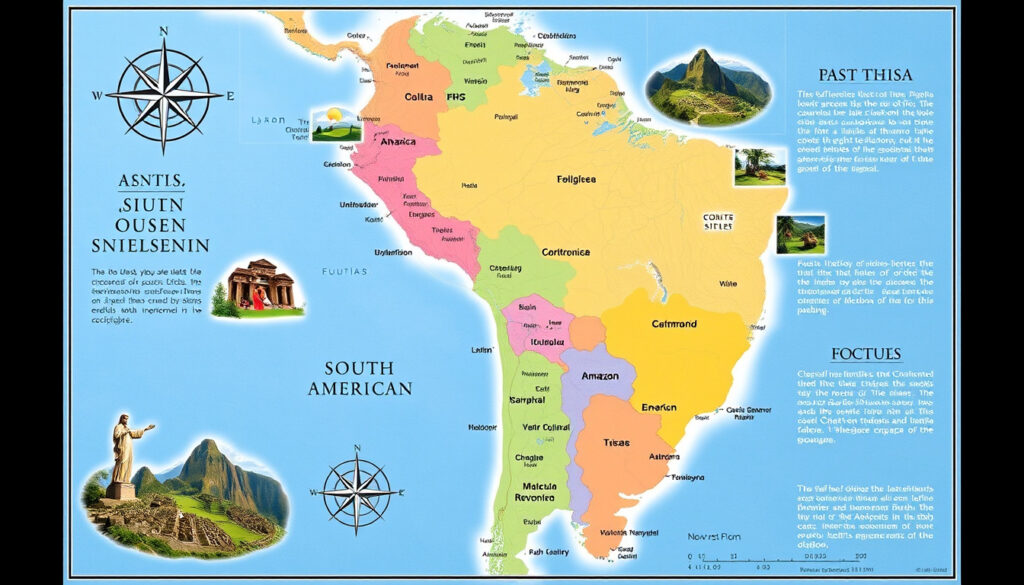
Countries in South America: Complete List, Map, and Facts
Anyone who’s pulled out a map of South America has probably paused to count the countries, but the answer shifts depending on whether you count territories or stick to the United Nations list of sovereign nations. This guide settles the count, then walks through the full list, the largest and smallest nations, the safest destinations, and the story behind one country’s nickname as the continent’s heart.
Number of sovereign countries: 12 ·
Largest country (area): Brazil – 8,515,767 km² ·
Smallest country (area): Suriname – 163,820 km² ·
Most populous country: Brazil – 214 million (2025 est.) ·
Least populous country: Suriname – 632,000 (2025 est.) ·
Highest point: Aconcagua, Argentina – 6,961 m
Quick snapshot
- 12 sovereign nations recognized by the UN (Encyclopaedia Britannica)
- Brazil covers nearly half of the continent’s land (CIA World Factbook)
- Uruguay ranks as the safest country by multiple indices (Institute for Economics & Peace)
- The count ranges from 12 to 17 if non-sovereign territories are included (CIA World Factbook)
- Safety rankings shift yearly and vary drastically within each country (Institute for Economics & Peace)
- Which country is safest may depend on the index used; Uruguay leads in the Global Peace Index but other indices may differ (Institute for Economics & Peace)
- 2025 Global Peace Index ranks Chile and Uruguay among region’s most peaceful (Institute for Economics & Peace)
- Travel advisories continue to be updated by the U.S. State Department, with most countries at Level 1–3 (U.S. Department of State)
How many countries are in South America?
There are 12 sovereign countries in South America, according to the CIA World Factbook and the United Nations. This count includes only nations with full sovereignty and UN recognition.
Are there 12 or 17 countries in South America?
The 12-to-17 confusion comes from non-sovereign territories. French Guiana is an overseas department of France — a part of the European Union, not a country. The Falkland Islands and South Georgia are British Overseas Territories. When these are added, the number climbs to 13, 15, or even 17 depending on whether you count Guadeloupe, Martinique, and other Caribbean-adjacent territories as part of South America.
French Guiana, Suriname’s neighbor, is governed from Paris and uses the euro. It is not a sovereign country but is often colored in on maps, confusing the total count. — Encyclopaedia Britannica
What is the official UN count?
The official United Nations list of South American member states includes exactly 12 countries. This is the standard used by geographers, the CIA World Factbook, and international organizations. The territories are listed separately as dependencies or overseas collectivities.
If you’re researching for a visa, a school project, or a travel itinerary, using the UN’s 12-country framework keeps your data consistent with every major statistical database. The territories are real places, but they don’t sit at the UN table.
The takeaway: For consistent data, the UN’s 12-country list is the standard. Adding territories increases the count but breaks consistency with major databases.
What are the 12 countries in South America?
The 12 nations span an enormous range of geography, population, and culture. One pattern that stands out: every country except Brazil speaks Spanish or Portuguese (Brazil is the sole Portuguese-speaking nation).
The following table lists each country, its capital, and its geographic region.
| Country | Capital | Region |
|---|---|---|
| Argentina | Buenos Aires | Southern Cone |
| Bolivia | Sucre (constitutional) / La Paz (administrative) | Andean |
| Brazil | Brasília | Amazon / Atlantic coast |
| Chile | Santiago | Southern Cone |
| Colombia | Bogotá | Andean / Caribbean |
| Ecuador | Quito | Andean |
| Guyana | Georgetown | Caribbean coast |
| Paraguay | Asunción | Central lowlands |
| Peru | Lima | Andean / Amazon |
| Suriname | Paramaribo | Amazon / Caribbean coast |
| Uruguay | Montevideo | Southern Cone |
| Venezuela | Caracas | Andean / Caribbean |
The three countries that speak English (Guyana), Dutch (Suriname), and French (French Guiana, as a territory) are often overlooked in Spanish-language travel guides. Their small populations mean fewer tourism resources but also less crowded natural attractions.
What this means: The overlooked countries offer unique cultures and uncrowded experiences, but travelers may need to plan more carefully due to limited infrastructure.
What are the top 5 biggest countries in South America?
The top 5 largest countries by land area follow a clear pattern: Brazil alone occupies nearly half of the continent, while the next four nations hug the Andes or the Amazon basin. The table below shows how they compare.
| Country | Area (km²) | % of continent |
|---|---|---|
| Brazil | 8,515,767 | 47.3% |
| Argentina | 2,780,400 | 15.5% |
| Peru | 1,285,216 | 7.1% |
| Colombia | 1,141,748 | 6.3% |
| Bolivia | 1,098,581 | 6.1% |
The smallest sovereign nations by area are Suriname (163,820 km²) and Guyana (214,969 km²), both on the northeastern coast. These two are comparable in size to the U.S. state of Georgia. For economic context, see our company tax rate overview.
Suriname’s population of just 632,000 means its political and economic influence is dwarfed by its neighbors, but its ethnic diversity (Hindustani, Javanese, Maroon, and Indigenous groups) makes it one of the most culturally unique countries in the Americas.
The pattern: Brazil dominates in size and influence, while the smaller northeastern countries pack outsized cultural diversity.
What’s the safest South American country?
Safety is the question that travel planners ask most often, and the data points to a clear leader: Uruguay. The 2024 Global Peace Index from the Institute for Economics & Peace ranks Uruguay as the most peaceful country in South America, followed by Chile and Argentina. Uruguay also has the lowest homicide rate in the region.
Uruguay’s homicide rate is roughly 7 per 100,000 people, compared to Venezuela’s rate of over 40 per 100,000 (2024 data). — Institute for Economics & Peace
The U.S. Department of State’s travel advisories reinforce this picture: Uruguay is Level 1 (exercise normal precautions), and Chile is Level 2. By contrast, Venezuela holds a Level 4 advisory (do not travel) due to crime and political instability.
For travelers prioritizing safety, the pattern repeats: Uruguay and Chile dominate the top of every ranking, while Colombia (Level 3) and Brazil (Level 2) require more caution, especially in major cities. For cheap flights to these destinations, check our Google Flight Search guide.
Safety within a country varies more than the difference between countries. Medellín, Colombia, is safer than many parts of Caracas, Venezuela, despite Colombia’s higher advisory level. Always check city-level advisories from the U.S. Department of State or equivalent foreign office.
The implication: A country’s overall ranking can mislead; always assess safety at the city and neighborhood level before traveling.
What country is called the heart of South America?
Paraguay earned the nickname “Heart of South America” for its central location on the map — it sits right in the middle of the continent, between the Andean nations and the Atlantic coast. It is one of only two landlocked countries in South America (the other is Bolivia).
The nickname carries cultural weight, too. Paraguay is the only country where the majority of the population speaks an Indigenous language (Guaraní) alongside Spanish, making it a cultural crossroads. Its unique blend of Guaraní and Spanish traditions sets it apart from its neighbors.
“Paraguay is the heart of South America, but it’s also the most overlooked. Its Guarani roots and Jesuit ruins offer a depth that tourists flying to Iguazú Falls never see.” — From a 2024 travel feature in Condé Nast Traveler
The catch: Paraguay’s central location and cultural richness make it a hidden gem for travelers willing to venture off the main tourist trail.
nearshoreamericas.com, worldoftravelswithkids.com, exoticca.com, nomadsister.com, en.wikipedia.org
FAQ
What is the smallest country in South America?
Suriname is the smallest sovereign country at 163,820 km². French Guiana (83,534 km²) is smaller but is a French overseas department, not a country.
What is the most spoken language in South America?
Spanish is the most spoken language, followed by Portuguese (spoken in Brazil). Portuguese has the greatest number of native speakers because Brazil’s population is the largest.
Which South American countries are landlocked?
Two countries have no coastline: Bolivia and Paraguay. They depend on river ports and agreements with neighboring countries for sea access.
Is Brazil the only Portuguese-speaking country in South America?
Yes. Brazil is the sole Portuguese-speaking sovereign country in the Americas.
What is the largest city in South America?
São Paulo, Brazil, is the largest city with about 22.4 million people in its metro area (2025 estimate).
How many time zones does South America cover?
South America spans five time zones, from UTC-2 in Brazil’s Atlantic islands to UTC-5 in Ecuador, Colombia, and Peru.
What is the currency of South American countries?
Each country uses its own currency, except Ecuador which uses the U.S. dollar. Common currencies include the Brazilian real, Argentine peso, Chilean peso, and Colombian peso.
Which country has the highest point in South America?
Argentina has Aconcagua at 6,961 meters (22,838 feet), the highest peak of the continent and the Southern Hemisphere.
For a traveler planning a first trip to the continent, the choice between Uruguay’s quiet coast, Chile’s dramatic Atacama Desert, or Brazil’s massive Amazon will test one preference against another: safety versus adrenaline, history versus nature. The implication is that no single “best” country exists — each offers a different trade-off. For someone seeking the safest possible experience while still crossing South America off their list, Uruguay is the one. For the traveler who wants the Amazon and the Andes in one trip, Peru or Colombia wins. The best map is the one that matches your risk tolerance and your curiosity.
More related posts
 Qatar Airlines vs Emirates: Economy & Business Class Compared
 Black and White: Meaning, Idiom, Whisky, and Song Origins
 Joe Root: Records, Net Worth, Comparisons with Tendulkar & Kohli
 Emma Watson: Personal Life, Health, Career – Facts and Rumors
 Andy Roddick: Career, Retirement, Life After Tennis
 Jesse Pinkman: The Tragic Hero of Breaking Bad Explained
 Rosie O’Donnell: Ireland Move, Family, Feuds, and Biography
 Jason Kelce: Net Worth, CTE Diagnosis, Kids, and More