Hot Pot Guide: Origins, Health, and Ordering
Few meals blur the line between cooking and conversation as gently as hot pot: you sit down with raw ingredients, a simmering broth, and everyone becomes a sous-chef. Japanese government records trace shabu-shabu, hot pot’s best-known Japanese offshoot, to an Inner Mongolian dish called Xiao Wei Yang (Government of Japan, national culture guide).
Global popularity: Originated in China, widely adapted in East Asia and beyond ·
Typical ingredients: Thinly sliced meats, vegetables, mushrooms, tofu, noodles ·
Common broth types: Spicy Sichuan, mild chicken, tomato, mushroom ·
Serving style: Communal, with dipping sauces ·
Health rating: Can be high in sodium and fat depending on broth and dipping sauces
Quick snapshot
- Chinese hot pot is the broader cooking tradition; shabu-shabu is a specific Japanese variant (Web Japan / NIPPONIA, official Japanese culture magazine).
- Hot pot, also known as steamboat, keeps a stock simmering in a pot at the table (Wikipedia, community-written reference).
- Shabu-shabu’s modern form is tied to Osaka in the early 1950s (Savor Japan, Japanese dining guide).
- Where modern shabu-shabu was first served — Kyoto’s Junidanya or Osaka’s Suehiro — is still told differently by different sources; according to Wikipedia’s shabu-shabu entry, the Suehiro origin story is the most widely repeated.
- The exact historical origin of hot pot within China is debated.
- A single official calorie count for hot pot doesn’t exist; the range depends heavily on broth, portions, and sauces.
- 1952: the name shabu-shabu is coined at Suehiro in Osaka (MATCHA, Japan travel media).
- 1952: a steak restaurant in Osaka names the dish after the swish of cooking meat (LIVE JAPAN, Japan travel guide).
- 1955: the dish reaches Tokyo, according to Wikipedia’s shabu-shabu entry. (MATCHA, Japan travel media)
- Choosing a clear broth, lean meat, and plenty of vegetables turns hot pot into a genuinely balanced meal.
- Steamed and vegetable-based Chinese dishes remain the safer order for health-focused diners.
- In Australia, Cantonese-style hot pot is already common in major cities, and supermarket ingredients keep expanding.
Seven details, one pattern: hot pot is simple in structure but wildly variable in execution — the broth and the table spread decide everything.
| Label | Value |
|---|---|
| Origin | China (Mongolia/Sichuan) |
| Typical Broth | Spicy or mild |
| Cooking Method | Simmering at table |
| Common Dipping Sauces | Sesame, garlic, soy |
| Calories (approx per serving) | 500–800 kcal depending on broth and ingredients |
| Shabu-shabu debut | Osaka, 1952 (MATCHA, Japan travel media) |
| Broader category | Chinese hot pot, with shabu-shabu as a Japanese variant (Web Japan / NIPPONIA) |
What exactly is a hot pot?
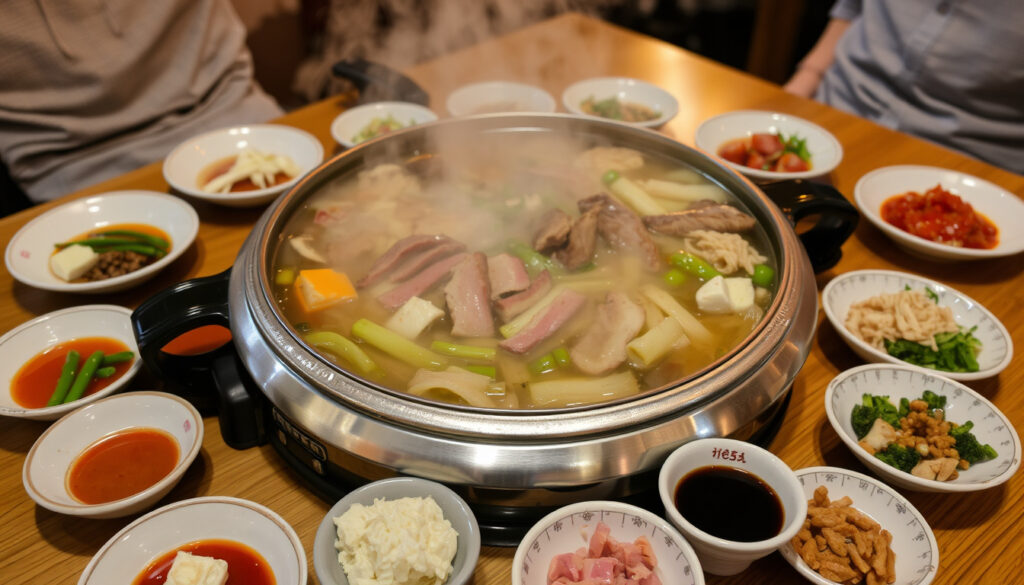
Hot pot is a communal dish where raw ingredients are cooked in a simmering broth at the table. The pot sits in the middle, the broth bubbles, and each diner lowers meat, vegetables, or noodles into the liquid with chopsticks or a small strainer. According to Wikipedia’s coverage of the dish, hot pot — also known as steamboat — is a soup or stock kept simmering in a pot by a heat source on the table (Wikipedia, community-written reference).
What equipment is needed for hot pot?
- A wide pot — a divided “yin-yang” pot if you want a spicy and a mild broth side by side.
- A portable burner or induction plate to keep the broth at a steady simmer.
- Chopsticks, a slotted spoon, or a small wire strainer for retrieving cooked pieces.
- Small bowls and a dipping-sauce station for each diner.
None of this is complicated. The equipment list is short because the broth does the cooking — everything else just moves food from pot to bowl. The shabu-shabu side of the family works the same way: JapanKuru, a Tokyo food and travel guide, describes it as a pot-and-broth style where diners cook sliced meat themselves in the simmering liquid.
What are common hot pot ingredients?
- Thinly sliced meats — beef, lamb, pork, or chicken.
- Vegetables — leafy greens, mushrooms, corn, lotus root.
- Tofu, tofu puffs, and other soybean products.
- Noodles, rice cakes, or potatoes to round out the meal.
- Dipping sauces — sesame, garlic, soy, chili oil.
The key is the slice. Meat cut paper-thin cooks in seconds; thicker cuts sit longer and turn tough. The pattern holds from Chinese hot pot to Japanese shabu-shabu: a central broth, a table of raw ingredients, and a social rhythm that turns dinner into a slow event.
How does hot pot differ from fondue?
- Hot pot cooks your food in broth — the cooking liquid becomes part of the meal.
- Classic fondue uses melted cheese, oil, or chocolate as a dipping base, not a cooking stock.
- Hot pot is a main course; fondue is usually an appetizer or dessert by comparison.
The real difference is what sits in the center pot: a stock you could drink versus a cheese or chocolate base you only dip into. If someone asks whether hot pot and fondue are the same, the answer is no — one is dinner, the other is a dip.
Is hotpot a Chinese or Japanese dish?
The short answer: the family is Chinese; shabu-shabu is the Japanese branch that grew out of it. The Government of Japan (national culture guide) describes shabu-shabu as a relatively recent addition to Japanese cuisine, rooted in an Inner Mongolian hot-pot dish called Xiao Wei Yang.
The same government source traces an early adapted version to a Kyoto eatery named Junidanya in the early twentieth century. Web Japan / NIPPONIA, the official Japanese culture magazine, points to a Beijing dish called shuan yang rou as the closer ancestor, noting that the Japanese version replaced the original mutton with beef. So “Chinese or Japanese?” is the wrong question: Chinese hot pot is the broad tradition, and shabu-shabu is a specific mid-20th-century Japanese take on it.
What is the difference between Chinese hot pot and Japanese shabu shabu?
- Broth: Chinese hot pot ranges from fiery Sichuan ma la to mild stock; shabu-shabu usually starts with a lighter, kelp-based broth.
- Protein: Chinese spreads can include lamb, beef, seafood, and offal; shabu-shabu is built around thinly sliced beef that diners cook themselves (JapanKuru, Tokyo food and travel guide).
- Motion: the name shabu-shabu comes from the Japanese onomatopoeia for swishing meat in the broth (Savor Japan, Japanese dining guide).
- Finish: shabu-shabu often ends with noodles or rice cooked in the now-flavoured broth; Chinese hot pot more often leaves the broth behind.
According to Gurunavi, a Japanese restaurant guide, hot-pot dining in Japan is much older than shabu-shabu itself, which only took shape around the mid-20th century. JapanKuru agrees, describing shabu-shabu as inspired by Chinese hot pot cuisine.
Is hot pot Korean too?
- Korea has its own hot-pot family, including jeongol, a broth-based casserole cooked at the table.
- Budae jjigae (army stew) is a Korean fusion dish that combines broth, processed meats, and instant noodles.
- These are related ideas, but they are not the same dish as Chinese hot pot.
If a Korean menu says “hot pot,” it usually means jeongol or a similar tabletop stew. The cooking concept crosses borders easily; the specific broths and seasonings do not. No single country owns hot pot — the family is pan-Asian, with distinct national dialects.
What is the history of hot pot in China?
- The Mongolian hot pot tradition produced mutton-focused dishes like Xiao Wei Yang, which the Japanese government cites as a root of shabu-shabu.
- Beijing’s shuan yang rou is the lamb-based variation that Web Japan links to shabu-shabu’s lineage.
- Sichuan’s ma la hot pot added the mouth-numbing spice that made Chinese hot pot globally famous.
Where exactly the first hot pot appeared is debated: official Japanese sources point to Inner Mongolia, while Japan’s own culture magazine points to Beijing. Both strands agree the practice of cooking raw meat in a shared pot is centuries old in the region. Sichuan’s spicy version became the international poster child, but the original hot pot was likely a simple lamb broth.
The trade-off: calling hot pot “Chinese” or “Japanese” depends on which strand you’re tracing. Chinese hot pot is the broad tradition; shabu-shabu is a 20th-century Japanese branch with its own name, its own sauces, and its own etiquette. Both labels are true — you just have to say which slice of history you mean.
Are hot pots unhealthy?
The honest answer: it depends on what you put in the pot. A hot pot meal built on a clear broth, lean meat, and vegetables can be one of the more balanced meals on a Chinese menu. The same setup with an oily Sichuan base and heavy sesame sauce can quickly become dense in calories, sodium, and fat.
The Government of Japan (official e-magazine) places shabu-shabu inside a broader Japanese hot-pot culture known as mizutaki-nabe — literally “cooked-in-water hot pot.” A water-based broth is about as lean a cooking medium as exists; almost all the calories arrive through the meat, the sauces, and the fried sides you add.
Why do I get diarrhea after eating hotpot?
- Spicy broth: capsaicin can irritate sensitive stomachs and speed up digestion.
- High oil content: a heavy Sichuan base is a large amount of fat in one sitting.
- Raw or undercooked ingredients: meat that doesn’t spend enough time in the broth can carry bacteria.
- Dipping-sauce overload: rich sesame or peanut sauces add fat and calories quickly.
None of these are reasons to swear off hot pot. The most common trigger is probably a combination — very spicy, very oily broth plus a larger-than-usual portion. If your stomach is sensitive, start with a mild broth and make sure meat is fully cooked before it reaches your bowl. Treat the pot like a stove, not a buffet.
How can I make hot pot healthier?
- Choose a clear broth (chicken, tomato, mushroom) instead of an oil-heavy spicy base.
- Pick lean proteins — chicken breast, fish, tofu — over marbled beef and lamb.
- Fill half the table with vegetables and mushrooms.
- Use dipping sauces sparingly; sesame sauce is delicious but energy-dense.
- Sip the broth only if it’s a light base; the spicy, oily version is mostly sodium and fat.
This is where hot pot’s flexibility works in your favour. You’re not ordering a fixed dish; you’re building a meal in real time. The healthiest plate on the table is usually the one with the most vegetables and the least fried anything.
What are the healthiest broths for hot pot?
- Chicken stock — mild, low-fat, easy on the stomach.
- Tomato broth — adds flavour without heavy cream or oil.
- Mushroom broth — savoury and low-calorie.
- Mizutaki-style water or kelp broth — the leanest possible base, in the Kansai tradition the Japanese government describes.
The healthiest broth is the one you drink least. Deep-fried and pre-seasoned bases are the traps; a simple stock lets the ingredients taste like themselves.
A hot pot meal is exactly as healthy as the broth and sauce you choose. Skip the oily spicy base and the heaviest dips and you cut most of the calorie and sodium risk before the first slice of meat lands in your bowl.
What this means: hot pot isn’t inherently unhealthy, but it is inherently customizable. If you order the default — spicy broth, fatty meat, heavy sauce — you’ll get a heavy meal. If you build the pot yourself with a light broth and mostly plants, you’ll get something closer to a balanced dinner.
What is the healthiest Chinese dish to order?
At a Chinese restaurant, the healthiest orders share a pattern: steamed, lightly sauced, and vegetable-forward. The least healthy share the opposite pattern: fried, twice-fried, or coated in a thick sugary glaze. Hot pot fits into the healthy side only if you build it that way.
What not to order at a Chinese restaurant?
- Fried rice and crispy noodles — refined starch plus oil.
- Sweet-and-sour anything — usually battered, then coated in sugar-heavy sauce.
- Battered and glazed chicken dishes — fried protein under a thick, sweet coating.
- Egg rolls and spring rolls — fried wrappers with a small vegetable payoff.
None of these are “bad” foods. But if you’re building a spread around a hot pot, they add calories without adding much in the way of vegetables or lean protein.
What is the most unhealthy Chinese food dish?
- Crispy fried duck or fried chicken — double cooking means double oil.
- Deep-fried appetizers — spring rolls, wontons, crispy noodles.
- Sugar-glazed mains — sweet-and-sour pork, honey walnut prawns.
These are the dishes nutrition guidance usually flags: a fried base, a sugary or salty coating, and minimal vegetables. It’s the combination of refined starch, oil, and sugar that pushes them to the top of any “most unhealthy” list.
What is the healthiest meal from Chinese takeaway?
- Steamed fish or chicken with vegetables.
- Mixed vegetables with tofu (often called Buddha’s delight).
- Clear soups — wonton soup in a light broth, or a simple vegetable soup.
- Brown rice instead of fried rice.
Ask for sauce on the side. That single move can cut a takeaway meal’s sodium by a meaningful margin, because most Cantonese-style and Chinese-American sauces are built on soy, sugar, and oil. A hot pot night is the natural extension of this logic: you control every ingredient, so the healthiest meal is the one you assemble yourself.
Fried appetizers alongside hot pot can double the meal’s calorie density before the broth arrives. If you want something crispy, order one plate for the table and fill the rest of the spread with vegetables — the contrast is the point.
What is a hot pot in Australia?
In Australia, hot pot is exactly what it is everywhere else: a communal pot of simmering broth, a spread of raw ingredients, and a meal that lasts two hours because nobody wants to leave. It’s especially popular in cities with large Asian communities, where Cantonese-style hot pot is a familiar weekend gathering.
Where can I find hot pot near me in Australia?
- Capital-city Chinatowns — Sydney, Melbourne, Brisbane, and Perth — all have dedicated hot pot restaurants.
- Suburban areas with strong East Asian communities, such as Chatswood, Box Hill, and Sunnybank, are hot pot hubs.
- Search for “hot pot,” “steamboat,” or “Chinese buffet” — steamboat is the Cantonese and Hong Kong term for the same idea.
The easiest way to spot a real hot pot restaurant: look for photos with a built-in burner in the table. That’s the tell — the room is set up for simmering, not just serving.
What are popular hot pot restaurants in Australia?
- Cantonese-style steamboat restaurants — common in Sydney and Melbourne, often with seafood-heavy spreads.
- Sichuan hot pot chains — scattered across the capitals, known for the spicy ma la broth.
- Japanese shabu-shabu restaurants — smaller but growing, especially in Sydney and Melbourne.
Names change quickly in a market this competitive, so the reliable strategy is to look for busy tables and a broth list with at least a mild and a spicy option. Cantonese-style hot pot, with its emphasis on seafood and clear broths, remains the most common format in Australia.
How to make hot pot at home in Australia?
- Buy a divided hot pot pan (or any wide pot) and a portable induction burner.
- Pick a broth base: chicken stock, tomato, mushroom, or a Sichuan ma la paste from an Asian grocery.
- Slice meat thin — ask the butcher to slice beef or lamb for hot pot, or buy pre-sliced shabu-shabu meat.
- Prep vegetables, mushrooms, tofu, and noodles in advance.
- Set up a dipping-sauce bar: sesame paste, garlic, soy, chili oil, spring onion, cilantro.
Australian supermarkets increasingly stock shabu-shabu-style sliced meat, enoki mushrooms, and tofu puffs, so assembling hot pot at home doesn’t require a specialty store. The whole meal comes together faster than a roast and keeps everyone at the table longer.
First-time hot pot diners in Australia often undercook meat or leave a spicy broth bubbling too long. Cook thin slices until they change colour completely, keep raw chopsticks away from cooked food, and don’t drink the oily broth at the end — that’s where the sodium and fat hide.
Why this matters: for Australian diners, hot pot is no longer an exotic import — it’s a mainstream group dinner in every major city. It’s also one of the few meals where the diner controls the nutrition, the pace, and the conversation.
Two cooking traditions, one shared mechanic: the pot is just the stage; the broth, the protein, and the ritual are what change.
| Attribute | Chinese hot pot | Japanese shabu-shabu |
|---|---|---|
| Origin | China (Inner Mongolia/Sichuan traditions) | Osaka, Japan, mid-20th century (Savor Japan) |
| Broth | Spicy Sichuan ma la to mild stocks | Light kelp or water-based broth, following the mizutaki tradition |
| Main protein | Lamb, beef, seafood, offal | Thinly sliced beef, adapted from the original mutton |
| Name meaning | Describes the simmering pot itself | Japanese onomatopoeia for the swishing motion of cooking meat (Savor Japan) |
| Cooking motion | No fixed rule | The swish-and-lift motion that gives the dish its name |
| Typical spread | Meats, vegetables, tofu, noodles, mushrooms | Beef, vegetables, tofu, and mushrooms with dipping sauce |
Upsides
- You control the nutrition — clear broth, lean meat, and vegetables make it a genuinely balanced meal.
- Protein and vegetables arrive in one pot, with no separate cooking needed.
- The communal format keeps the table engaged and turns dinner into an event.
- Highly customizable for low-carb or gluten-free needs, as long as you choose sauces carefully.
Downsides
- Sodium and fat can climb fast with rich broths and heavy sesame sauces.
- Raw meat at the table means food-safety discipline matters; undercooked ingredients are a common trigger behind “hot pot diarrhea.”
- The meal can get expensive with premium meats and restaurant markups.
- Very spicy broths can irritate sensitive stomachs.
Confirmed facts
- Hot pot originated in China and spread through East Asia (Web Japan / NIPPONIA).
- Shabu-shabu is a Japanese variant, popularized from Osaka in the early 1950s (Savor Japan).
- Hot pot can be high in sodium and fat depending on broth and dipping-sauce choices.
What’s unclear
- The exact birthplace of hot pot within China is debated — official Japanese sources point to Inner Mongolia, while Japan’s culture magazine points to Beijing.
- Where modern shabu-shabu was first served is told differently: a Kyoto eatery (Junidanya) versus an Osaka restaurant (Suehiro).
- Nutritional values vary so widely by recipe that any single “hot pot calories” figure is unreliable.
What the sources say
“Shabu-shabu’s origin can be traced to a Beijing dish called shuan yang rou.”
Web Japan / NIPPONIA (official Japanese culture magazine)
“The dish was named shabu-shabu by a steak restaurant in Osaka in 1952.”
“The current form of shabu-shabu was developed in 1952 at Eiraku-cho Suehiro Honten in Osaka.”
MATCHA (Japan travel media)
Hot pot rewards the people who pay attention. A light broth, lean meat, and a table full of vegetables make it one of the most balanced group meals you can share; a spicy oil-heavy base with fried sides and thick sauces turns it into a sodium bomb with a longer dinner. For Australian diners, the choice is clear: make the broth light, the meat thin, and the vegetables half the table — or skip hot pot entirely and pick the steamed dishes instead. The pot doesn’t decide; you do.
restaurants-guide.tokyo, givingtuesday.jp, gov-online.go.jp, japanesewiki.com
Frequently asked questions
Can you eat hot pot if you have high blood pressure?
Yes, with care. Choose a low-sodium clear broth, use sesame dipping sauce sparingly, and build the meal around vegetables and lean protein. The main risk is hidden sodium in packaged broth bases and soy-based sauces.
What are the best dipping sauces for hot pot?
The classic trio is sesame paste, garlic, and soy sauce, with chili oil for heat. For a lighter option, mix soy sauce with vinegar, chopped spring onion, and a little garlic instead of a sesame-heavy base.
How long does it take to cook hot pot?
Thinly sliced meat cooks in 10 to 30 seconds in a rolling broth. Vegetables and tofu take a few minutes; dense items like potatoes, corn, or lotus root need up to 10 minutes.
Is hot pot gluten-free?
It can be, if you choose gluten-free soy sauce (or tamari), a broth base without wheat, and skip processed items like imitation crab or certain meatballs.
How do I set up a hot pot at home?
You need a wide pot or divided hot pot pan, a portable burner, broth, thinly sliced meat, vegetables, mushrooms, tofu, noodles, and dipping sauces. Prepare everything in advance, bring the broth to a steady simmer, and let each person cook their own portions.
More related posts
 Anthony Hopkins: Biography, Family, Health, and Career
 Adidas Spezial Women – Sizing, Fit and Buying Guide
 Soba Noodle Salad Recipe: Easy Cold with Sesame Dressing
 Monica Lewinsky: Biography, Scandal, Activism, Age, Net Worth
 Reece Walsh Headbutt: Fine, No Suspension, NRL Precedent
 Jelly Cat Australia Guide: Where to Buy, Exclusives & Pricing
 Clayton Utz: Historic Big 6 Law Firm & Gender Equality
 Marcello Hernandez: SNL, Girlfriend, Mom, Height, Netflix Special