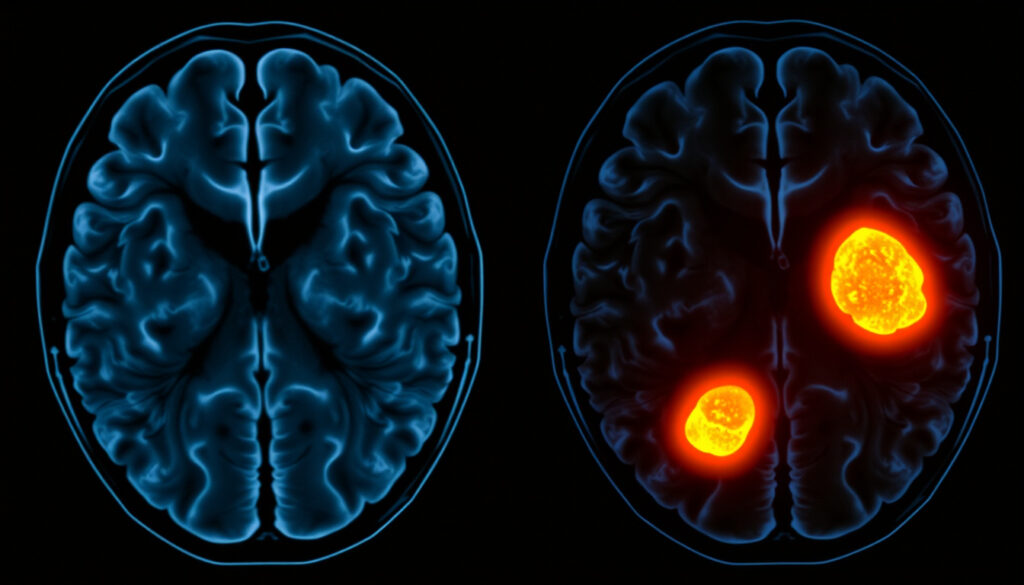
Brain Cancer Symptoms: Early Signs and Progression
Most of us have had a headache that felt like nothing serious — and usually it was. But when headaches cluster in the morning, or come alongside nausea or vision changes, the equation shifts. Brain cancer symptoms can be subtle at first, which is exactly why knowing what to watch for matters. This guide walks through the warning signs backed by clinical sources, how quickly symptoms tend to develop, and what the distinction between curable and aggressive tumors actually means.
Most Common Symptom: Headaches · Other Frequent Signs: Nausea, vomiting, seizures · Vision Issues Reported: Blurred or double vision · Behavioral Changes: Mood or personality shifts · Top Sources Agree On: Morning headaches worsening
Quick snapshot
- Headaches, seizures, and nausea rank as core symptoms across sources (Mayo Clinic)
- Symptoms of benign brain tumors develop over months or years (Mayo Clinic)
- Malignant tumors cause sudden symptoms that worsen within days or weeks (Mayo Clinic)
- The exact timeframe from tumor development to noticeable symptoms varies by individual (Mayo Clinic)
- Precise survival rates by tumor grade lack consensus across sources (Lone Star Neurology)
- Female-specific symptom patterns remain understudied in available literature (National Brain Tumor Society)
- Symptoms build over days, weeks, or months — unlike stroke, which strikes within minutes or hours (University of Utah Health)
- Glioblastoma symptoms reportedly can be gradual and undetectable at first (GBM Research)
- Most brain tumor patients spend approximately 1 month under hospice care (Brain Hospice)
- Rapid diagnosis remains critical for positive outcomes (Lone Star Neurology)
- Tumor location determines which neurological functions become impaired first (Mayo Clinic)
- Early intervention reportedly improves treatment options across tumor types (Lone Star Neurology)
Understanding these distinctions matters because brain tumors present differently than other neurological emergencies — and recognizing the pattern can literally save lives.
| Attribute | Details |
|---|---|
| Primary Symptom | Headaches (worse in morning) — Mayo Clinic |
| Secondary Signs | Nausea, vision loss — National Brain Tumor Society |
| Onset Pattern | Gradual or sudden, depending on tumor type — Mayo Clinic |
| Grading System | WHO grades 1–4, not staged like other cancers — Mayo Clinic |
| Grade 1 Tumors | Least aggressive, slow-growing — Mayo Clinic |
| Grade 4 Tumors | Most aggressive, fast-growing — Mayo Clinic |
| Stroke vs. Tumor Timing | Stroke: minutes to hours; Tumor: days to months — University of Utah Health |
What are the early warning signs of brain cancer?
Brain cancer rarely announces itself loudly. The World Health Organization classifies brain tumors on a 1–4 grading scale — not staged like other cancers — and symptom presentation varies accordingly. According to Mayo Clinic (a leading medical institution), the earliest and most frequently reported sign is a headache that feels different from typical tension or migraine pain, often worse upon waking.
Headaches especially in morning
Morning headaches rank among the most reported early symptoms. This pattern occurs because lying flat overnight allows pressure to build in the skull. According to GBM Research (a glioblastoma-focused research group), tension-type headaches frequently serve as the earliest detectable sign of glioblastoma — the most aggressive brain cancer subtype. Unlike everyday headaches, these tend to worsen with movement, straining, or changes in position.
Seizures and fits
Seizures represent another common symptom that prompts clinical evaluation. Lone Star Neurology (a neurology practice) notes that seizures can occur at any stage of brain cancer progression. Notably, a first-time seizure in an adult often triggers imaging tests specifically to rule out a brain tumor.
Vision and hearing changes
Vision problems — including blurry vision, double vision, or loss of peripheral vision — frequently accompany brain tumors depending on tumor location. Mayo Clinic identifies these as warning signs requiring medical evaluation. Hearing issues and balance problems similarly emerge when tumors affect areas controlling sensory processing.
Personality changes such as sudden mood swings, impulsivity, or emotional distancing may mimic psychiatric conditions — but University of Utah Health (academic medical center) reports these as genuine early warning signs when caused by frontal lobe involvement.
What are the 7 warning signs of brain cancer?
The National Brain Tumor Society outlines multiple categories of warning signs, though “seven” represents a common organizational grouping rather than a fixed clinical list. National Brain Tumor Society (a patient advocacy organization) emphasizes that symptoms depend heavily on where the tumor grows — each brain region controls different functions.
Persistent headaches
Repeated or worsening headaches that do not respond to usual treatments deserve investigation. Morning-dominant headaches, those that wake someone from sleep, or headaches increasing over weeks merit prompt evaluation.
Unexplained vomiting
Nausea and vomiting without gastrointestinal cause can indicate increased intracranial pressure. Mayo Clinic lists these as common symptoms accompanying brain cancer progression.
Cognitive difficulties
Memory loss, confusion, and difficulty concentrating affect daily life when tumors impact cognitive processing centers. According to National Brain Tumor Society, memory loss and confusion in everyday matters represent possible signs requiring clinical assessment.
Motor weakness (numbness or weakness in face, arm, or leg) and trouble speaking rank among symptoms requiring immediate medical attention per National Brain Tumor Society — these can indicate pressure on critical motor or language centers.
How fast do brain cancer symptoms appear?
Symptom onset speed depends on whether the tumor is benign or malignant. Mayo Clinic states that benign tumors develop slowly, often over months or years, while malignant tumors cause symptoms that appear suddenly and worsen within days or weeks.
Gradual onset common
Slow-growing tumors (typically Grade 1 or 2) allow symptoms to accumulate gradually. Patients may attribute early signs to stress, aging, or unrelated health issues — delaying diagnosis.
Sudden in aggressive cases
Glioblastoma and other Grade 4 tumors grow rapidly. According to GBM Research, glioblastoma symptoms can include headaches, confusion, memory loss, motor weakness, and seizures — often developing more quickly than patients expect.
Tumor growth factors
Key factors affecting symptom speed include tumor grade (1–4 per the WHO system), location within the brain, and how quickly the mass effect (pressure on surrounding tissue) develops.
“Brain cancer is an unpredictable and intractable disease. The faster cancer grows, the more serious the situation can become.”
— Lone Star Neurology
How long would you have a brain tumor without knowing?
This timeline varies substantially based on tumor type, location, and growth rate. The critical distinction lies in how brain tumor symptoms develop compared to other neurological emergencies.
Months to years undetected
Low-grade tumors often permit months or years of unawareness. Mayo Clinic notes that benign brain tumor symptoms develop slowly over extended periods.
Slow-growing tumors
Grade 1 tumors — classified as the least aggressive by Mayo Clinic — grow slowly and may produce such mild symptoms that diagnosis delays considerably.
Early subtle signs
Subtle early signs include mild personality changes, occasional headaches dismissed as tension, or slight coordination changes. University of Utah Health reports that brain tumors may present with stroke-like symptoms including partial vision loss on one side and sudden personality changes — potentially causing confusion if not properly evaluated.
Stroke symptoms occur within minutes or hours, while brain tumor symptoms build slowly over days, weeks, or months — University of Utah Health provides this clinical distinction, yet both require urgent evaluation.
The implication: this gradual progression means patients and caregivers may dismiss early symptoms as unrelated conditions, allowing tumors to grow undetected while time-sensitive treatment windows close.
Is brain cancer curable?
Curability depends on tumor type, grade, location, and patient factors. Lone Star Neurology (a neurology practice) reports that Stage I brain cancer is generally considered the most curable form. However, the term “curable” requires careful interpretation — some tumors can be removed surgically with no recurrence, while others remain managed rather than cured.
Depends on stage and type
Grade 1 tumors that can be completely resected often carry favorable prognoses. Mayo Clinic confirms that Grade 4 tumors are the most aggressive with lower survival rates than lower-grade tumors.
Surgery and treatment options
Surgical removal, radiation therapy, chemotherapy, and targeted drug therapy represent standard treatment pathways. The extent of surgical resection significantly influences outcomes.
Survival factors
Factors affecting survival include age at diagnosis, tumor size and location, extent of resection, and molecular markers. According to Lone Star Neurology, rapid diagnosis remains key to positive outcomes regardless of tumor grade. Mayo Clinic adds that early intervention expands treatment options across tumor types.
“Rapid diagnosis of brain cancer is key to a positive outcome.”
— Mayo Clinic
What the evidence confirms
- Headaches, seizures, and nausea constitute core symptoms across multiple tier-1 sources
- The WHO grading system (1–4) classifies tumor aggressiveness rather than cancer staging
- Malignant tumors cause sudden symptom onset versus benign tumors’ gradual development
- Tumor location determines which neurological functions become impaired
Where uncertainty remains
- Precise timeframe from tumor inception to symptom visibility varies by individual
- Survival statistics by grade lack consistent reporting across sources
- Female-specific symptom patterns require further research per National Brain Tumor Society
- Hemiparesis and aphasia reportedly affect some glioblastoma patients but exact prevalence unclear per GBM Research
Related reading: low blood sugar symptoms · new COVID symptoms
Frequently asked questions
What is the first stage of a brain tumor?
Brain tumors use grades rather than stages. Grade 1 represents the least aggressive form — slow-growing with the most favorable prognosis per Mayo Clinic. Grade 4 represents the most aggressive and fastest-growing tumors.
What is life expectancy after brain cancer?
Prognosis varies dramatically by tumor grade, type, location, and patient age. Mayo Clinic notes that Grade 4 tumors carry lower survival rates, while Grade 1 tumors may be removable with no recurrence. Specific statistics vary by individual circumstances.
At what age do brain tumors start?
Brain tumors can develop at any age. According to Mayo Clinic, some types are more common in children while others predominate in adults. Age-related incidence varies by tumor subtype.
What are brain cancer symptoms in females?
Core symptoms — headaches, seizures, vision changes, nausea — apply regardless of sex. National Brain Tumor Society notes that female-specific symptom patterns remain understudied in available literature, warranting discussion with healthcare providers familiar with individual patient history.
How to detect a brain tumor at home?
No home test reliably detects brain tumors. Lone Star Neurology emphasizes that persistent, worsening, or unusual neurological symptoms warrant prompt medical evaluation, typically including imaging (MRI or CT scan) ordered by a physician.
What are the 7 cancer warning signs?
The classic “7 warning signs” framework includes unexplained weight loss, persistent fatigue, pain, changes in bowel/bladder habits, persistent cough, unexplained bleeding, and a lump or thickening. However, brain tumor symptoms differ — National Brain Tumor Society focuses on neurological presentations including headaches, seizures, vision changes, weakness, and cognitive shifts.
For anyone experiencing persistent neurological symptoms — particularly morning headaches that worsen, unexplained seizures, or sudden personality changes — the path forward is straightforward: seek medical evaluation promptly. Patients who recognize these patterns early and act quickly give themselves the best chance at favorable outcomes, while those who dismiss gradual symptoms risk losing treatment windows that close as tumors advance.
More related posts
 Federal Election 2025 – Labor’s Historic Majority Win
 Little Red Riding Hood: Story, Moral & Origins Explained
 Roman Polanski: Biography, Legal Status, Latest Verified Info
 Treat Williams: Death, Tributes & Driver’s Guilty Plea
 Fixed-Term Employment Contract in Ireland: Right and Rule
 Pork Loin Roast: Cooking Time, Best Methods & Recipes
 Officeworks Narre Warren: Phone, Address & Services
 Lindy Chamberlain: Biography, Case and Aftermath