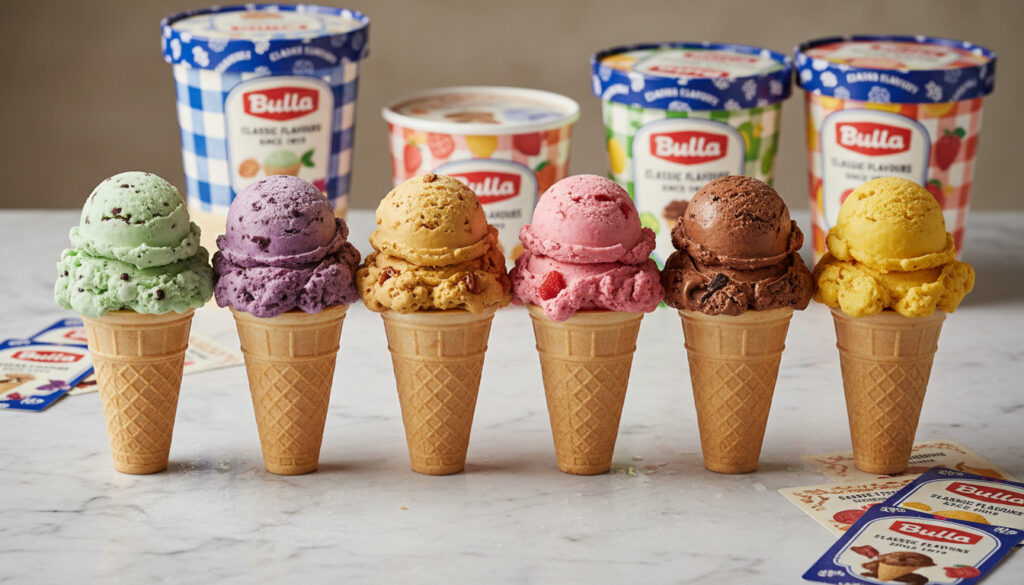
Bulla Ice Cream – History, Flavours, Where to Buy & Reviews
Bulla Ice Cream stands as one of Australia’s most recognizable frozen dessert brands, with a legacy spanning more than a century of continuous family ownership. Trading under Bulla Dairy Foods, the company has maintained its position as a dominant force in the national ice cream market through a focus on traditional dairy craftsmanship and local sourcing.
Established in 1910 by Thomas Sloan in Moonee Ponds, Melbourne, the operation began as the Bulla Cream Company, utilizing wood-fired coppers to pasteurize cream sourced from regional Victorian farms. Today, the business remains under the control of descendants from the original founding families, now in their sixth generation, while sourcing milk from over 270 family farms nationwide.
The brand achieved particular prominence in 2019 when Roy Morgan research identified Bulla as Australia’s top-selling ice cream in supermarkets, securing a significant share of the nation’s billion-dollar frozen dessert sector alongside competitors like Peters and Unilever.
What is Bulla Ice Cream?
- Australian Brand: Family-owned dairy producer since 1910
- Core Products: Ice cream tubs in classic and premium flavours
- Availability: Major supermarkets across Australia
- Key Strength: Creamy texture from fresh Victorian dairy
- Sources milk from over 270 family farms across Australia today
- Became the largest southern hemisphere wholesaler of cream
- Reached top-selling status in Australian supermarkets in 2019 per Roy Morgan research
- Exports premium products to over 20 countries including Japan
- Acquired Cadbury and Brownes ice cream brands in 2009
- Maintains six generations of continuous family ownership
| Fact | Details |
|---|---|
| Founded | 1910, Moonee Ponds, Victoria |
| Founder | Thomas Sloan |
| Ownership | Bulla Dairy Foods (family-owned, 6th generation) |
| Headquarters | North Melbourne (since 1928) |
| Flagship Flavours | Vanilla, Caramel, Strawberry, Honeycomb Crunch |
| Product Lines | Creamy Classics, Regal Cream, Cadbury, Brownes |
| Market Position | 2019 supermarket sales leader (Roy Morgan) |
| Export Reach | 20+ countries (Asia-Pacific, Japan) |
| Farm Network | Over 270 family farms |
Detailed ownership and operational information is available through the company’s official historical documentation.
What Flavours Does Bulla Ice Cream Offer?
The company’s ice cream portfolio centres on the Creamy Classics range, which serves as the flagship line for retail consumers. Available documented options include Caramel, Strawberry, Honeycomb Crunch, Roasted Almonds, Belgian Selection, Milk Chocolate, and the iconic Classic variety that has defined the brand since the post-World War II era.
Additional product formats extend beyond traditional tubs. The company manufactures Choc Bars, Merry Go Rounds, and Petite Creams, catering to different serving preferences and occasions. Through strategic acquisitions, Bulla also distributes ice cream under the Regal Cream, Cadbury, and Brownes brand names, expanding their flavour portfolio through these subsidiary labels.
Vanilla ice cream became Bulla’s iconic flagship product following World War II, establishing the brand’s reputation for quality that continues today. The company maintains traditional recipes while sourcing dairy exclusively from Australian farms.
Does Bulla Produce Dairy-Free Alternatives?
Available sources indicate that Bulla specializes exclusively in dairy-based frozen desserts. Research reveals no mention of dairy-free ice cream or plant-based alternatives within the company’s current product range. All referenced items—including ice cream, cream, yogurt, and cottage cheese—contain dairy ingredients sourced from the company’s network of over 270 farms.
Where Can You Buy Bulla Ice Cream?
Domestic availability spans the entire Australian continent, with products distributed nationally from the company’s Victorian production facilities. Major supermarket chains including Woolworths and Coles stock Bulla tubs prominently, reflecting its status as the 2019 top-selling supermarket ice cream brand according to Roy Morgan research data.
Independent grocers and IGA stores also carry the range, ensuring accessibility beyond the major metropolitan centres. The brand’s distribution network supports its position as a staple in the Australian frozen dessert aisle, with manufacturing rooted in Victoria but delivery capabilities reaching remote regions.
For consumers monitoring supermarket specials, checking the Aldi Catalogue This Week – Super Savers and Special Buys may provide context on frozen dessert pricing trends across the retail sector, though Bulla specifically maintains widespread availability at Woolworths and Coles.
International Availability
Beyond domestic markets, Bulla exports to more than 20 countries across the Asia-Pacific region and Japan. The company has successfully positioned its premium products in international markets, leveraging its reputation for Australian dairy quality to compete abroad.
Specific retail pricing for Bulla ice cream tubs is not documented in available sources. Consumers should check individual supermarket websites or in-store displays for current pricing, as costs vary by retailer and promotional periods.
Is Bulla Ice Cream Good? Reviews and Nutrition
Market data provides objective measures of consumer preference. In 2019, Roy Morgan research identified Bulla as Australia’s top-selling ice cream in supermarkets, indicating broad consumer acceptance and repeat purchase behaviour within the competitive billion-dollar Australian ice cream market.
Historical documentation supports this commercial success with qualitative assessments. Early accounts praise the superior taste and quality of Bulla’s butter and cream deliveries, a standard that appears to have translated into their frozen dessert lines. The company’s post-World War II vanilla ice cream launch established a benchmark for quality that contemporary products maintain.
Nutritional Profile
Specific nutritional data—including calorie counts, fat content, and ingredient percentages—does not appear in available research sources. The company produces low-fat cottage cheese and lite yogurt variants, suggesting a capacity for health-conscious product development, but exact nutritional specifications for ice cream ranges require direct consultation of product packaging or the official manufacturer website.
All Bulla ice cream products contain dairy ingredients. Consumers with lactose intolerance or dairy allergies should verify specific formulations on packaging, as no dairy-free alternatives are documented in current sources.
How Has Bulla Dairy Foods Evolved Since 1910?
- : Thomas Sloan establishes the Bulla Cream Company in Moonee Ponds, Melbourne, pioneering wood-fired copper pasteurization techniques.
- : Hugh Anderson joins the family operation, expanding production capabilities.
- : Jack Anderson enters the business, establishing the division of roles between production, marketing, and distribution that would define the company’s structure.
- : Expansion continues with the opening of a factory in Colac, Victoria.
- : Headquarters relocate from Moonee Ponds to North Melbourne, centralizing operations.
- : Acquisition of Regal Ice Cream expands the company’s frozen dessert portfolio.
- : Launch of vanilla ice cream and yogurt lines, establishing the brand’s flagship frozen products.
- : Bulla acquires Cadbury and Brownes ice cream brands following Fonterra’s divestment, significantly increasing market share.
- : Roy Morgan research confirms Bulla as Australia’s top-selling supermarket ice cream brand.
What Facts Are Established and What Remains Uncertain?
Verified Information
- Australian-made using local dairy from over 270 family farms
- Continuous family ownership across six generations since 1910
- 2019 supermarket sales leadership confirmed by Roy Morgan
- Specific flavour ranges including Creamy Classics and acquired brands
- Export operations to 20+ countries including Japan
Unclear or Unconfirmed
- Exact nutritional values and calorie counts per serving
- Specific retail pricing across different supermarket chains
- Existence of dairy-free or plant-based product lines
- Future expansion plans or new flavour development schedules
- Aggregated consumer satisfaction ratings or star reviews
How Does Bulla Fit Into the Australian Ice Cream Market?
Bulla occupies a distinctive position within Australia’s frozen dessert landscape, competing directly with multinational giants like Unilever and domestic rivals such as Peters. The company’s family-owned status provides a point of differentiation in a market valued at over one billion dollars, emphasizing local provenance and traditional manufacturing methods against industrial-scale competitors.
Under chief executive officer Allan Hood, the company emphasizes sustainability and innovation while maintaining the family values established by Thomas Sloan over a century ago. This operational philosophy supports a supply chain integrating more than 270 family farms, creating a vertically integrated model that controls quality from raw milk through to packaged retail products.
The brand’s success in export markets, particularly Japan and the Asia-Pacific region, demonstrates the international appeal of Australian dairy credentials. This dual focus—dominating local supermarket shelves while expanding globally—reflects a business model balancing heritage craftsmanship with modern market demands.
What Documentation Supports Bulla’s Claims?
Primary source material for Bulla’s history derives from the Australian Food Timeline, which documents the company’s 1910 founding and subsequent expansion through family records and industrial archives. The Hotham History Project provides additional verification of early 20th-century operations in Melbourne’s northern suburbs.
Contemporary market position claims rely on 2019 Roy Morgan research cited by multiple industry observers, confirming Bulla’s status as the highest-selling supermarket ice cream brand nationally. The company’s official corporate history corroborates ownership details and generational succession, while executive interviews with CEO Allan Hood provide insight into current operational philosophy regarding sustainability and family stewardship.
Key Takeaways on Bulla Ice Cream
Bulla Ice Cream represents a rare example of continuous family ownership in the Australian food sector, maintaining six generations of control while achieving market leadership in 2019 supermarket sales. The brand offers traditional dairy-based frozen desserts through major retailers like Woolworths and Coles, sourcing ingredients from over 270 local farms, though consumers seeking specific nutritional data or dairy-free alternatives should verify current product specifications directly with retailers. Those interested in broader supermarket trends might also consult the 1 Cup Butter in Grams – Exact US, AU & UK Weights for related dairy measurement guidance.
Does Bulla ice cream have dairy free options?
Available sources indicate Bulla specializes exclusively in dairy-based products. No dairy-free ice cream or plant-based alternatives are documented in current research, with all referenced items containing dairy ingredients.
How much does Bulla ice cream cost?
Specific pricing information for Bulla tubs is not available in published sources. Prices vary by retailer and promotional periods, requiring direct checking of supermarket websites or in-store displays at Woolworths, Coles, and other stockists.
Is Bulla ice cream good quality?
Bulla ranked as Australia’s top-selling supermarket ice cream in 2019 Roy Morgan research. Historical accounts consistently praise the superior taste of Bulla dairy products dating back to the company’s early butter and cream deliveries.
Who founded Bulla Dairy Foods?
Thomas Sloan founded the Bulla Cream Company in 1910 in Moonee Ponds, Melbourne. He pioneered pasteurization techniques using wood-fired coppers and sourced milk from local Victorian farms including his brother William’s property in the Bulla district.
Which countries does Bulla export to?
Bulla exports premium ice cream products to over 20 countries, with established markets across the Asia-Pacific region and Japan, leveraging Australian dairy quality standards for international distribution.
Does Bulla own other ice cream brands?
Yes, Bulla acquired Regal Ice Cream in 1930, and subsequently purchased the Cadbury and Brownes ice cream brands from Fonterra in 2009, expanding their portfolio beyond the flagship Bulla label.
Where is Bulla ice cream manufactured?
Bulla ice cream is manufactured in Victoria, Australia. The company operates facilities that have evolved from the original 1910 Moonee Ponds site to modern production centres supporting national distribution and export markets.
How many farms supply Bulla with milk?
Contemporary operations source milk from over 270 family farms across Australia. This network supplies the dairy ingredients for Bulla’s ice cream, cream, yogurt, and cottage cheese product lines.
More related posts
 Song Hye-kyo: Dating History, Age & Career Facts
 Chevy Chase: Health Issues, Feuds, and Career Biography
 Bli ful Little Home Review , Stocki t & Di count Code (2025)
 Vermont Medical Clinic – Adult Primary Care in South Burlington
 Kiara Advani: Age, Baby, Husband, Religion, and More
 Neil Diamond’s Health, Marriages, and Lasting Legacy
 Amy Poehler: Relationships, Children, Friendship with Tina Fey
 Rob Reiner’s Death: Cause, Tributes, and Son’s Arrest