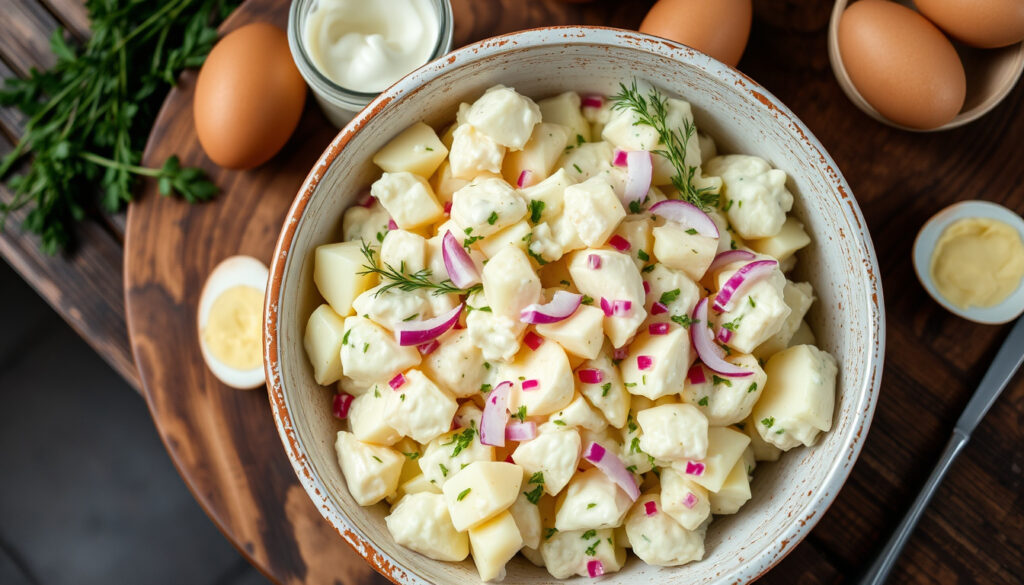
Classic Potato Salad Recipe: Jamie Oliver & Mary Berry
The perfect potato salad often feels like a memory, but the fundamentals are simpler than you’d think. This guide covers essential ingredients, common pitfalls, and surprising upgrades to turn a good potato salad into a standout side dish.
Total Time: 45 minutes ·
Servings: 6 ·
Difficulty: Easy ·
Key Ingredients: Potatoes, mayonnaise, onion, celery ·
Calories per serving: ~250 kcal
Quick snapshot
- Potatoes should be cooked until just tender (Delish (US recipe publisher))
- Mayonnaise-based dressings are the classic choice (Kitchen Sanctuary (UK food blog))
- Adding vinegar or lemon juice prevents blandness (Taming Twins (UK recipe blog))
- Whether to peel potatoes or leave skin on is largely a matter of preference
- Best herb pairing varies by region — chives, dill, parsley all work
- Whether to include eggs is a matter of regional preference
- Boil potatoes for 10 to 15 minutes; chill at least 30 minutes before serving (Taming Twins (UK recipe blog))
- Try the 1-ingredient upgrade: crispy bacon for texture and saltiness
What Ingredients Go in a Potato Salad?
The classic British lineup is deceptively short: boiled potatoes, a creamy dressing, and a handful of aromatics. Most versions start with potatoes, binding, and seasoning, but the variations reveal real character.
Essential ingredients
Six ingredients, one pattern: the base is almost identical across top sources, but the dressing is where the personality lives.
| Ingredient | Classic (mayo-based) | Vinaigrette version | Lighter version |
|---|---|---|---|
| Potato type | Yukon Gold or red-skinned (Delish) | New potatoes (YouTube recipe guide) | Salad potatoes (Taming Twins) |
| Binding | Mayonnaise + optional salad cream (Kitchen Sanctuary) | Mustard vinaigrette | Greek yoghurt + mayonnaise (Taming Twins) |
| Acid | Lemon juice + pickles (Delish) | White wine vinegar | Cider vinegar (Taming Twins) |
| Aromatics | Red onion, chives (Delish) | Shallots, parsley | Spring onion, gherkins (Taming Twins) |
| Protein (optional) | Hard-boiled eggs (Delish) | None | None |
| Seasoning | Paprika, mustard, salt (Delish) | Salt, pepper | Dijon mustard, white pepper (Kitchen Sanctuary) |
Optional add-ins
- Crispy bacon — adds saltiness and crunch
- Pickled gherkins or capers — brings acidity and bite (Taming Twins)
- Fresh dill or chives — brightens the overall flavour
- Crème fraîche — a richer, less tangy alternative to yoghurt
The takeaway: the backbone of a great potato salad is a well-chosen potato and a dressing that doesn’t dominate. The add-ins are where you personalise it.
What Is the Secret to a Good Potato Salad?
Ask any experienced cook and they’ll point to two things: potato choice and temperature. Get those right and you’re most of the way there.
Choosing the right potato
Waxy potatoes such as new potatoes, red-skinned potatoes, or Yukon Golds hold their shape after boiling (Delish). Floury potatoes like Russets break apart and create a mushy texture — a common mistake.
Kitchen Sanctuary recommends red-skinned potatoes peeled and chopped into bite-size chunks for the best texture. (Kitchen Sanctuary)
Cooking technique
- Boil whole then cut: This prevents waterlogging. If you cut before boiling, pieces absorb more water and become mushy.
- Salt the water generously: The YouTube guide suggests adding salt, sugar, and white wine vinegar to the cooking water for deeper seasoning (YouTube recipe guide).
- Cook until just tender: Delish advises boiling for 12 to 15 minutes until easily pierced with a knife (Delish). Kitchen Sanctuary recommends 7 to 9 minutes for chopped pieces (Kitchen Sanctuary).
- Season while warm: Warm potatoes absorb salt and acid more readily than cold ones. Toss them with a splash of vinegar or lemon juice while still warm, then let them cool before adding the dressing.
Dressing balance
A great dressing is a balance of creamy and tangy. The classic ratio is roughly 3 parts fat (mayonnaise or yoghurt) to 1 part acid (vinegar or lemon juice), plus a little mustard for heat. Taming Twins uses Greek yoghurt, mayonnaise, cider vinegar, and Dijon mustard for a lighter, tangier profile (Taming Twins).
The pattern: choosing the right potato and dressing balance are the non-negotiables for a memorable result.
How Do Top Chefs Make Potato Salad?
Jamie Oliver and Mary Berry offer two distinctly different takes on potato salad, and comparing them reveals how small tweaks produce big flavour differences.
Jamie Oliver’s New Potato Salad with Vinaigrette
Jamie Oliver’s version skips the mayonnaise entirely. He uses new potatoes, shallots, flat-leaf parsley, and a mustard vinaigrette dressing. The dressing typically includes olive oil, red wine vinegar, wholegrain mustard, salt, and pepper. The result is bright, fresh, and light — a perfect summer side that doesn’t sit heavy.
Mary Berry’s Classic Potato Salad
Mary Berry takes the creamy route. Her recipe uses mayonnaise, natural yoghurt, snipped chives, and hard-boiled eggs folded in at the end. She seasons with salt, white pepper, and a squeeze of lemon. Berry’s version is richer and more substantial, a classic British picnic staple.
The contrast: Oliver’s vinaigrette works for lighter meals or alongside grilled meats; Berry’s creamy version stands up to cold cuts and stands alone at a buffet. Both chefs emphasise not overcooking the potatoes — a shared non-negotiable.
What Is a Great 1-Ingredient Upgrade for Potato Salad?
One addition consistently transforms a serviceable potato salad into a memorable one: crispy bacon. It adds saltiness, crunch, and a savoury depth that balances the creamy dressing.
Adding crispy bacon
Fry streaky bacon until crisp, let it cool, and crumble it over the finished salad just before serving. The key is adding it at the last minute — if it sits in the dressing, it goes soft and loses its crunch.
Using pickles or capers
Pickled gherkins or capers inject acidity and a pop of brine that cuts through the richness of mayonnaise. Taming Twins includes finely chopped gherkins for this reason (Taming Twins).
Incorporating fresh herbs
Fresh dill and chives brighten the overall flavour. If you’re using dried herbs, add them to the dressing early so they can rehydrate. Fresh herbs should be stirred in at the end to keep their colour and aroma.
What Not to Do When Making Potato Salad?
Potato salad is simple, but three common mistakes can ruin it.
Overcooking potatoes
Mushy potatoes are the single biggest failure point. Boil until just tender — test with a knife at the 10-minute mark. The potatoes should offer slight resistance but slide off the knife easily.
According to Delish, ‘Potatoes should be cooked until just tender.’ (Delish)
Adding hot potatoes to dressing
Warm potatoes absorb dressing aggressively, which sounds good but results in soggy, oversaturated salad. Let them cool to room temperature (about 20 minutes) before mixing. Kitchen Sanctuary recommends cooling them completely before combining (Kitchen Sanctuary).
Using too much mayonnaise
Excess mayonnaise masks the potato flavour and turns the salad greasy. Start with a smaller amount than you think you need — you can always add more. The goal is a light coating, not a dip.
Potato salad left at room temperature for more than two hours becomes a food-safety risk. Delish advises refrigerating until ready to serve rather than leaving it out on the counter (Delish).
The implication: food safety should not be overlooked when preparing this picnic classic.
Step-by-Step Classic Potato Salad
- Boil whole waxy potatoes in salted water until just tender (12–15 minutes).
- Drain and let cool to room temperature, then cut into bite-size chunks.
- While potatoes cool, mix dressing: mayonnaise, yogurt or vinegar, mustard, and seasonings.
- Combine potatoes with dressing, add chopped onions, celery, and any optional add-ins.
- Taste and adjust seasoning, then chill for at least 30 minutes before serving.
- Garnish with fresh herbs and crispy bacon just before serving.
For a traditional take on this dish, you can follow a classic British potato salad recipe that highlights the same techniques used by Jamie Oliver and Mary Berry.
Frequently asked questions
Can I use sweet potatoes instead of white potatoes?
Yes, but expect a sweeter, softer result. Sweet potatoes break down more easily, so cut them into larger chunks and watch the cooking time closely.
How long does potato salad keep in the refrigerator?
Properly stored in an airtight container, potato salad keeps for 3 to 5 days. Discard if it develops an off smell or sliminess.
Can I freeze potato salad?
Freezing is not recommended. The mayonnaise dressing separates upon thawing, and the potatoes turn grainy and watery.
What is the best way to reheat potato salad?
Cold potato salad is traditional, but if you prefer it warm, reheat gently in a pan over low heat, adding a splash of milk or stock to restore moisture.
Is potato salad gluten-free?
Yes, as long as you don’t use malt vinegar or any vinegar that contains gluten. Standard mustard and mayonnaise are gluten-free.
How can I make potato salad vegan?
Substitute plant-based mayonnaise or a vinaigrette dressing. Omit eggs and use chickpeas or tofu as a protein add-in if desired.
The evidence shows that potato salad is versatile, but proper storage and substitutions are key to success.
Related reading: Looking for more salad inspiration? Try our Soba Noodle Salad Recipe with Sesame Dressing for a cold, tangy alternative. For heartier mains, see Pork Loin Roast: Cooking Time and Best Methods.
The evidence is clear: a great potato salad lives in the details — the potato variety, the cooking time, the dressing balance, and the final garnish. For the home cook serving a British picnic or barbecue, the choice is straightforward: master the creamy classic, experiment with the vinaigrette, and never skip the crispy bacon.
More related posts
 Roger Federer: Health, Wealth, and Djokovic Rivalry
 Philippine Peso to AUD – Current Rate, History and Guide
 Scott Selwood: Age, Wife, Net Worth, and AFL Exit
 Orlando Magic vs Lakers Match Player Stats: Box Score & Analysis
 Asics Running Shoes – Best 2025 Models and Fit Guide
 Alex Kingston: Biography, Cancer, Divorce, and Strictly
 Black and White: Meaning, Idiom, Whisky, and Song Origins
 Brooke Shields’ Health, Family, and Career Timeline