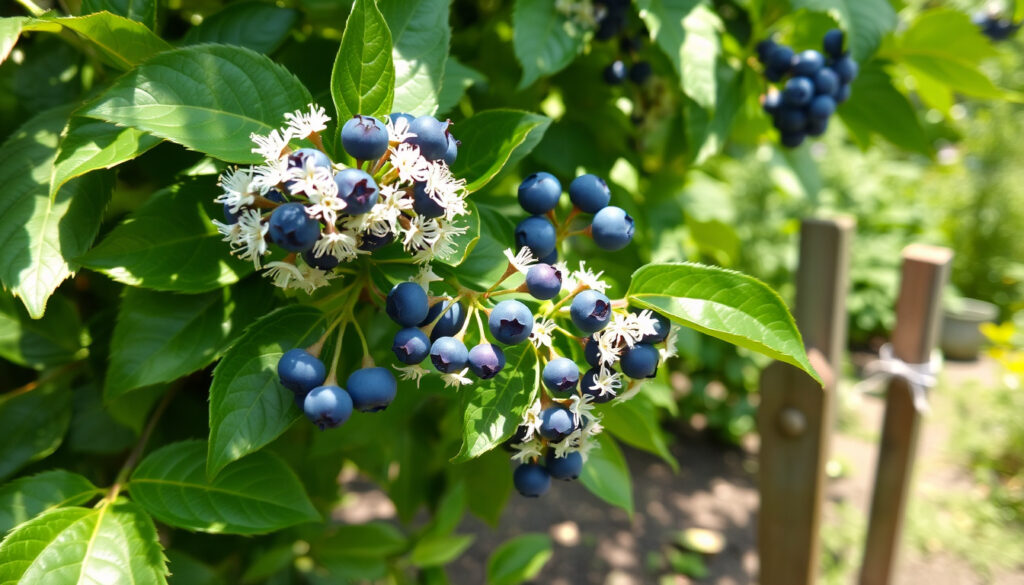
Blueberry Ash: Complete Growing Guide and Care Tips
If you’re after a native tree that fits into a tight spot without taking over the garden, Blueberry Ash is the answer. This narrow evergreen from eastern Australia offers a neat silhouette, delicate flowers, and even edible fruit—all while asking for surprisingly little fuss.
Common height: 8–15 meters (26–49 feet) ·
Width: 3–5 meters (10–16 feet) ·
Foliage type: Evergreen ·
Flower color: White or pink ·
Fruit color: Blue ·
Growth rate: Moderate
Quick snapshot
- Elaeocarpus reticulatus is an evergreen tree (Australian Native Plants Society (national horticultural body))
- Produces blue fruit that is edible but not flavorful (Wikipedia (community-maintained encyclopedia))
- Has a narrow growth habit suitable for screening (Eco Organic Garden (organic gardening resource))
- Roots are non-invasive (Seasol (specialist plant nutrition company))
- Exact price range across all Australian retailers not formally compiled (Evergreen Trees Direct (nursery supplier))
- Precise growth rate (e.g., cm per year) not widely published (Evergreen Trees Direct (nursery supplier) estimates 50–80 cm/year)
- Hardiness to frost varies by provenance (Seasol (specialist plant nutrition company) notes young plants may need frost protection)
- Reportedly grows 50–80 cm per year under ideal conditions (Evergreen Trees Direct (nursery supplier))
- Can reach 8–15 m at maturity after 20+ years (same source)
- Moderate lifespan exceeding 50 years (Australian Native Plants Society (national horticultural body))
- Ideal for narrow garden beds and privacy screens (Eco Organic Garden (organic gardening resource))
- Can be pruned into a hedge or kept as a specimen tree (Eco Organic Garden (organic gardening resource))
- Seeds available from specialty nurseries and online suppliers
Key botanical details for Blueberry Ash, from family classification to propagation methods.
| Attribute | Details |
|---|---|
| Botanical name | Elaeocarpus reticulatus |
| Family | Elaeocarpaceae |
| Common names | Blueberry Ash, Ash Quandong, Fairy Petticoats |
| Native range | Eastern Australia (Queensland to Tasmania) |
| Lifespan | Moderate to long-lived (>50 years) |
| Propagation | Seed or semi-hardwood cuttings |
What conditions do Blueberry Ash like?
Sunlight requirements
- The species can grow in full sun to heavy shade, according to the Australian Native Plants Society (national horticultural body).
- Eco Organic Garden (organic gardening resource) recommends a sunny position, though it tolerates light shade (source).
Gardeners with a north-facing fence can plant Blueberry Ash against it without worrying about deep shade slowing growth—the tree adapts.
Soil preferences
- Well-drained soil is a consistent requirement across guides, including Seasol (specialist plant nutrition company).
- Rich, moist soil that drains well is preferred (Eco Organic Garden (organic gardening resource)).
Watering needs
- Regular watering during establishment is critical; once established, it tolerates moderate dryness.
- The Seasol guide highlights tolerance of coastal conditions, meaning salt spray isn’t a problem.
The implication: Blueberry Ash suits a range of exposures and soils—the only non‑negotiable is good drainage. Soggy ground invites root rot.
How do you grow Blueberry Ash?
Planting steps
- Plant in spring or autumn when soil temperatures are mild.
- Dig a hole twice as wide as the root ball and the same depth. Improve drainage if needed.
- Water in thoroughly and apply a layer of organic mulch around the base (keep it away from the trunk).
Ongoing care and maintenance
- Water regularly during the first two years, especially through dry spells.
- Mulch annually to retain moisture and suppress weeds.
- Prune lightly after flowering to maintain shape or for hedge use. No heavy pruning needed.
Young Blueberry Ash plants may need frost protection in inland areas, as noted by Seasol (specialist plant nutrition company). A sheltered position or frost cloth in the first two winters avoids tip damage.
Why this matters: With minimal aftercare, Blueberry Ash becomes a self‑sufficient tree—perfect for time‑poor gardeners who still want a tidy hedge.
What are the benefits of Blueberry Ash?
Ornamental value
- Produces white or pink bell‑shaped, fragrant flowers in summer (Wikipedia (community-maintained encyclopedia)).
- Dense, dark green foliage with a narrow silhouette makes it one of the most space‑efficient screening plants.
Wildlife attraction
- Blue fruits attract birds, as noted by Backyard Buddies (Australian wildlife education program).
- Flowers provide nectar for bees and other pollinators.
Edible fruit
- Fruit is edible but described as “bland” by Wikipedia.
- Can be used in jams or jellies if sweetened.
What this means: You get a year‑round visually pleasing tree, a bird magnet, and the novelty of edible berries—all from one plant.
Is Blueberry Ash an evergreen tree?
Foliage type
- Yes—Blueberry Ash is an evergreen tree or shrub (Wikipedia).
- Leaves are oblong with serrated margins, remaining on the plant year‑round.
Growth habit
- Dense canopy provides privacy even in winter.
- Narrow form (3–5 m spread) differentiates it from many other evergreens that need more width.
The pattern: If you need a privacy screen that doesn’t turn into a jungle, this evergreen’s compact habit is the key advantage.
What are the pros and cons of Blueberry Ash trees?
Advantages for gardens
- Non‑invasive root system – safe near foundations and paths.
- Low maintenance – few pests or diseases (Seasol).
- Adaptable to a range of light and soil conditions.
Potential drawbacks
- Can suffer from root rot in poorly drained soil.
- Requires protection from strong winds when young (Seasol).
- Growth rate may be slower than other screening species like Lilly Pilly.
Upsides
- Non-invasive roots
- Low pest/disease issues
- Narrow form fits small gardens
- Evergreen with attractive flowers and fruit
Downsides
- Root rot risk in wet soil
- Young plants need wind protection
- Moderate growth rate
- Frost sensitivity in inland areas
The trade-off: You sacrifice speed for safety—Blueberry Ash won’t crack your driveway or outgrow your block, but it asks for patience.
Blueberry Ash vs other native screening plants
Three popular narrow evergreens, one key difference: root aggression. Blueberry Ash stays gentle, while some natives don’t.
| Feature | Blueberry Ash | Lilly Pilly (Acmena smithii) | Pittosporum (Pittosporum undulatum) |
|---|---|---|---|
| Mature height | 8–15 m | 5–15 m | 8–15 m |
| Width | 3–5 m | 3–5 m | 4–6 m |
| Growth rate | Moderate (50–80 cm/yr) | Fast (up to 1 m/yr) | Fast |
| Root system | Non-invasive | Moderate (some species invasive) | Can be invasive near structures |
| Flowers | White/pink, fragrant | White fluffy, not fragrant | White, fragrant |
| Fruit | Blue, edible but bland | Purple/pink, edible tasty | Orange capsules, not edible |
| Frost tolerance | Low (young need protection) | Moderate to high | Moderate |
| Pest/disease | Few problems | Psyllid, scale, rust | Root rot, leaf spot |
Sources: Blueberry Ash data from ANPSA and Evergreen Trees Direct; Lilly Pilly data from Weeping Lilly Pilly guide; Pittosporum data from Seasol.
What this means: For a low‑maintenance, root‑friendly screen, Blueberry Ash wins. For speed or fruit, Weeping Lilly Pilly has the edge—but watch for pests.
Blueberry Ash specifications
Six details that define this species, from leaf shape to flower size.
| Specification | Value |
|---|---|
| Leaf shape | Oblong, 5–12 cm long, serrated edges |
| Flower type | Bell‑shaped, 1–2 cm across |
| Flower season | Summer (December–February in Australia) |
| Fruit size | ~1 cm diameter, round, blue |
| Bark | Smooth, greyish |
| Lifespan | Moderate to long (>50 years) |
The implication: Every part of this tree is measured—from leaf to fruit—making it predictable for gardeners.
Clarity: what we know and what remains uncertain
Confirmed facts
- Elaeocarpus reticulatus is an evergreen tree (ANPSA).
- Blue fruit is edible but not flavorful (Wikipedia).
- Narrow habit (3–5 m width) (Evergreen Trees Direct).
- Prefers moist, well‑drained soil and semi‑shade (Eco Organic Garden).
- Roots are non‑invasive (Seasol).
What’s unclear
- Exact price range across all Australian retailers – not formally aggregated.
- Precise annual growth rate – only one nursery reports 50–80 cm/year (Evergreen Trees Direct).
- Frost hardiness varies by provenance – no standardized data.
- Market availability of the Prima Donna cultivar across states.
The takeaway: Most claims about Blueberry Ash are well-supported by authoritative sources, but growth rate and frost hardiness data remain limited.
What the experts say
Blueberry ash is usually evergreen and has attractive white or pink flowers followed by blue fruit.
Wikipedia (community-maintained encyclopedia)
Blueberry ash prefers rich, moist soil that drains well, and tolerates full sun to light shade.
Eco Organic Garden (organic gardening resource)
Final thought
Blueberry Ash delivers exactly what narrow‑space gardeners need: an evergreen screen that won’t damage hardscapes, requires little upkeep, and rewards with flowers and fruit. For the suburban Australian gardener, the choice is clear: plant one and wait a few years, or plant a Lilly Pilly and fight psyllids. Neither is perfect, but Blueberry Ash is the peace‑of‑mind option.
malleedesign.com.au, nurserynearme.com.au, flat-cap-gardener.com, nurserynearme.com.au, bie.ala.org.au, youtube.com
For those interested in cultivating this versatile native, the Blueberry Ash growing guide provides detailed advice on planting, care, and pruning.
Frequently asked questions
Does Blueberry Ash attract birds?
Yes. The blue fruits attract birds, as noted by Backyard Buddies.
Can Blueberry Ash be grown in a pot?
It can be grown in a large container for a few years, but mature height makes it better suited for garden beds.
Is Blueberry Ash toxic to pets?
There is no evidence of toxicity. The fruit is edible for humans, so pets are generally safe, but supervision is wise.
When does Blueberry Ash flower?
It flowers in summer (December–February in Australia).
How far apart should I plant Blueberry Ash for a hedge?
Space plants 1.5–2 meters apart to form a dense screen.
Can Blueberry Ash tolerate frost?
Young plants need frost protection (Seasol). Mature trees are more tolerant but care is advised in frost‑prone areas.
Does Blueberry Ash need pruning?
Light pruning after flowering keeps shape tidy and encourages denser growth. Heavy pruning is unnecessary.
How long does it take for Blueberry Ash to grow to full height?
At a reported 50–80 cm per year (Evergreen Trees Direct), it may take 15–25 years to reach 8–15 m.
More related posts
 Kiara Advani: Age, Baby, Husband, Religion, and More
 Marcello Hernandez: SNL, Girlfriend, Mom, Height, Netflix Special
 Amal Clooney: Biography, Age, Twins, Net Worth & Career Facts
 Roman Polanski: Biography, Legal Status, Latest Verified Info
 Liv Tyler: Cancer Battle, Family, and Lord of the Rings Legacy
 Loyle Carner: Real Name, ADHD, Sober, Baby, Tour & Songs
 Tash Sultana: Gender, Partner, Ethnicity, and Wife’s Health News
 James Hunt: Death, Niki Lauda, and the Accuracy of Rush