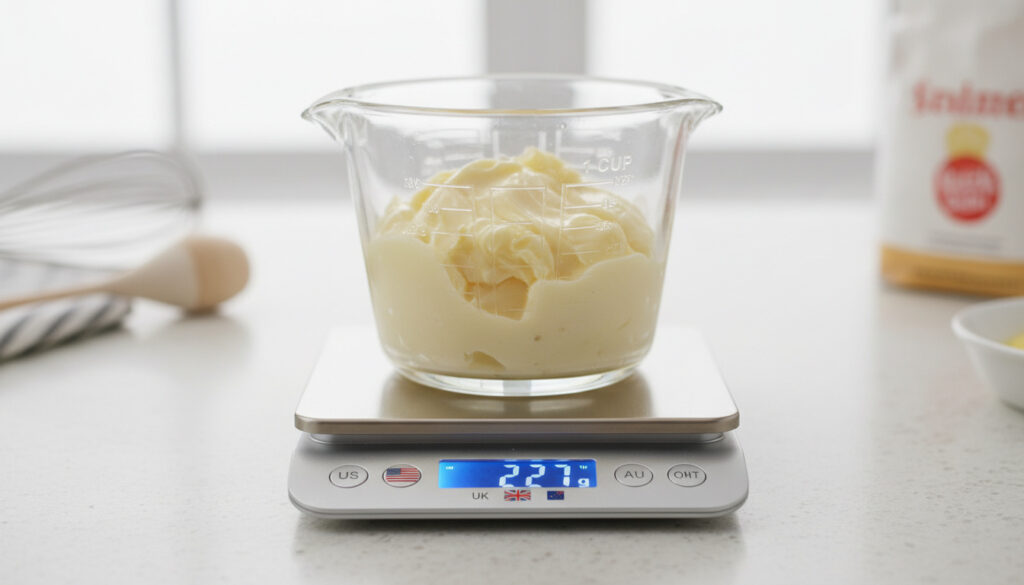
1 Cup Butter in Grams – Exact US, AU & UK Weights
One cup of butter equals approximately 227 grams in the United States, though this figure shifts depending on geographic location and measurement standards. Australian bakers work with 250 grams per cup, while United Kingdom recipes often cite 240 grams for the same volume. These variations stem from differences in cup definitions—the US cup holds 240 milliliters, whereas Australian metric cups contain 250 milliliters.
Precision in butter measurement proves critical for baking chemistry. Unlike cooking, where approximate ratios suffice, pastry and cake recipes rely on specific fat-to-flour ratios to achieve proper texture and rise. A discrepancy of even 20 grams can alter the crumb structure of delicate cakes or the spread of cookies.
This guide provides exact conversion factors for American, Australian, and British standards, explores the relationship between sticks and cups, and examines whether salted versus unsalted varieties affect weight. We also address practical measurement techniques to ensure accuracy in home kitchens.
How Many Grams Are in 1 Cup of Butter?
The standard conversion for one cup of butter in American recipes is 227 grams, based on USDA density calculations of approximately 0.911 grams per milliliter. This measurement assumes the butter is at refrigerator temperature and packed firmly into the measuring cup without air gaps. Professional bakeries and tested cookbook recipes rely on this 227-gram baseline for consistency.
- American recipes standardize on 227 grams per cup, derived from 240ml volume measurements.
- Australian metric cups yield 250 grams due to the 250ml cup standard.
- United Kingdom measurements typically align with US standards at approximately 240 grams.
- One standard US stick of butter equals exactly half a cup.
- Salt content contributes less than 2 percent of total weight, making conversion identical for salted and unsalted varieties.
- Digital kitchen scales provide accuracy within one gram, eliminating packing inconsistencies inherent in volume measuring.
- Room temperature butter may weigh 1-2 percent more per cup due to density changes from softening.
| Measurement | Grams (US) | Grams (AU) | Sticks (US) | Notes |
|---|---|---|---|---|
| 1 cup | 227-230 | 250 | 2 | Standard reference |
| 1/2 cup | 113-115 | 125 | 1 | 1 stick |
| 1/4 cup | 57-60 | 60 | 1/2 | Half stick |
| 1/3 cup | 76-77 | 85 | 2/3 | Common fraction |
| 2/3 cup | 153 | 165 | 1 1/3 | Double 1/3 |
| 3/4 cup | 173 | 185 | 1 1/2 | Three quarters |
| 1 pound | 454 | 500 | 4 | 2 cups |
| 1 tablespoon | 14-15 | 20 | 1/8 | US vs AU differ |
| 1 teaspoon | 5 | 5 | — | Universal |
| 1 ounce | 28-30 | 28-30 | 1/4 | Weight ounce |
1 Cup Butter in Grams: US vs UK and Other Variations
Regional measurement standards create the primary confusion when converting cups to grams. The discrepancy originates not from the butter itself, but from the definition of a “cup” as a volume unit. Understanding these geographic variations prevents recipe failures when using international cookbooks or online recipes.
United States Standard Measurements
American culinary standards define one cup as 240 milliliters. Given butter’s density of approximately 0.95 grams per milliliter at room temperature, this yields 225 to 230 grams per cup. Most US butter packaging follows the “stick” system, where one cup equals precisely two sticks, with each stick weighing 113 to 115 grams. Cooking with Nana Ling confirms that two standard US sticks constitute one cup.
Australian Metric Conventions
Australia utilizes the metric cup of 250 milliliters, resulting in a higher gram weight for the same nominal “cup” measurement. One cup of butter in Australia equals 250 grams, precisely matching the standard block size sold in supermarkets. Half-cup measurements convert to 125 grams. Bake School notes that Australian recipes assume this 250-gram cup baseline, which explains why direct US-to-Australia recipe conversions often produce dense or dry results without adjustment.
United Kingdom and Canadian Practices
British and Canadian bakers typically encounter measurements falling between US and Australian standards. Most UK conversion charts cite 240 grams per cup, aligning with the 240ml US cup volume but occasionally rounding to 250 grams for simplicity. Doves Farm provides a detailed conversion table specifying 240 grams for one cup of butter in UK measurements.
Salted Versus Unsalted Butter Weights
Research indicates no meaningful weight difference between salted and unsalted butter when measured by volume. Salt constitutes less than 2 percent of the total weight in salted varieties, an amount insufficient to alter cup-to-gram conversions significantly. Both types maintain identical density characteristics, allowing bakers to use the same conversion factors regardless of salt content.
Always verify the origin of your recipe before measuring. A “cup” in an Australian recipe contains 4% more butter than a US cup, which can critically affect pastry texture and cake moisture.
Related Butter Measurements: Sticks, Half Cups, and More
Beyond the standard cup measurement, butter frequently appears in recipes as sticks, tablespoons, or fractional cups. Understanding these relationships streamlines preparation and reduces conversion errors.
How Many Grams in a Stick of Butter?
In the United States, one stick of butter weighs 113 to 115 grams and equals exactly half a cup or one-quarter pound. This standardization dates to early 20th-century dairy packaging conventions. KitchenAid’s conversion guide confirms that four sticks comprise one pound (454 grams) or two cups. Australian markets do not typically sell butter in sticks; instead, standard blocks weigh 250 grams, conveniently matching one metric cup.
Converting Half Cups and Quarter Cups
Fractional cup measurements follow consistent mathematical divisions of the whole cup weight. One-half cup equals 113 grams (US) or 125 grams (Australia). One-quarter cup converts to 57 grams (US) or 60 grams (Australia). Savor the Best provides a comprehensive PDF chart detailing these precise fractions down to tablespoon measurements.
Accurate Measurement Techniques
Volume measurements introduce variability due to packing density and air pockets. For precision, culinary professionals recommend weighing butter on a digital kitchen scale set to grams. When volume measurement proves necessary, pack cold butter firmly into the measuring cup and level the surface with a straight edge. Australian Women’s Weekly Food emphasizes that weighing eliminates the inconsistencies inherent in cup measurements.
Always weigh butter when baking pastry or cakes. A digital scale provides accuracy within one gram, while volume measurements can vary by 10-15 grams depending on how firmly the butter is packed.
Softened butter at room temperature may weigh 1-2% more per cup than cold butter due to density changes. For consistent results, measure butter while still cold from refrigeration, then allow it to soften if the recipe requires.
Butter Conversion Charts and Tools
Comprehensive conversion charts provide quick reference for common baking quantities. The following table aggregates standard measurements across regions for practical kitchen use.
| Cups | Grams (US) | Grams (AU) | Sticks (US) | Tablespoons |
|---|---|---|---|---|
| 1/4 | 57 | 60 | 1/2 | 4 |
| 1/3 | 76 | 85 | 2/3 | 5 1/3 |
| 1/2 | 113 | 125 | 1 | 8 |
| 2/3 | 153 | 165 | 1 1/3 | 10 2/3 |
| 3/4 | 173 | 185 | 1 1/2 | 12 |
| 1 | 227 | 250 | 2 | 16 |
| 2 | 454 | 500 | 4 | 32 |
Delicious Magazine offers additional conversion charts for other baking ingredients, ensuring comprehensive measurement accuracy across recipes.
Historical Context of Measurement Standards
The standardization of butter measurements evolved alongside dairy packaging innovations. Understanding this history clarifies why regional differences persist.
- : The US dairy industry adopts the “stick” format, standardizing 1/4 pound portions wrapped in parchment paper.
- : American cookbooks formalize the cup measurement system, defining one cup as half a pint (approximately 237ml, later standardized to 240ml).
- : Australia transitions fully to metric measurements, establishing the 250ml cup standard that differs from US customary units.
- : Global recipe sharing online necessitates careful attention to these historical regional standards.
Certainty and Variation in Butter Weights
While conversion standards provide reliable baselines, certain variables introduce uncertainty into butter measurements.
| Established Facts | Uncertain or Variable Factors |
|---|---|
| US cup = 227-230g (based on 240ml volume) | Exact weight of “packed” vs “lightly packed” butter (±5-10g variation) |
| Australian cup = 250g (based on 250ml volume) | Temperature effects on density (1-2% variation between cold and room temp) |
| Salted and unsalted butter weigh identically per cup | Brand-specific moisture content variations |
| 1 US stick = 113-115g | Air incorporation in whipped or European-style butters |
The Science Behind Butter Density
Butter consists of approximately 80 percent milk fat, 18 percent water, and 2 percent milk solids. This composition yields a density of roughly 0.9 to 0.96 grams per milliliter, slightly less than water. The density remains stable across salted and unsalted varieties because salt dissolves into the minimal water content without significantly altering volume.
For home bakers, this density translates to practical weighing strategies. Convert HEIC to JPG – Free Guide for Windows Mac iPhone While seemingly unrelated to baking, precision in digital conversions mirrors the precision required in culinary measurements.
Recipes requiring creaming—beating butter with sugar—depend on specific air incorporation that only occurs with the correct fat ratio. Too much butter creates greasy, flat cookies; too little produces dry, crumbly cakes.
Industry Standards and Expert Guidance
Professional baking organizations and culinary schools maintain strict standards for butter measurement to ensure recipe reliability.
“One cup of butter equals 227 grams in US measurements. We recommend weighing ingredients whenever possible, as volume measurements can vary by 10-15 percent depending on how the ingredient is packed.”
— King Arthur Baking Company
“Australian recipes assume a 250ml cup, which holds 250 grams of butter. This difference seems small but becomes significant in recipes requiring precise fat ratios.”
— Bake School Conversion Guidelines
New Balance 574 – Complete Sizing, History and Review Guide offers insights into precise measurement systems applied across different industries.
Quick Reference for 1 Cup Butter in Grams
One cup of butter weighs 227 grams in the United States, 250 grams in Australia, and approximately 240 grams in the United Kingdom. For consistent baking results, use a digital kitchen scale rather than volume measurements, and verify whether your recipe originates from a US, UK, or Australian source to select the appropriate conversion factor. When in doubt, the US standard of 227 grams serves as the most widely accepted international reference for recipe development.
Frequently Asked Questions
Does butter temperature affect cup-to-gram conversions?
Yes, room temperature butter may weigh 1-2% more per cup than cold butter due to density changes from softening. For accuracy, measure cold butter then soften if required.
Is there a weight difference between salted and unsalted butter?
No. Salt constitutes less than 2% of total weight, insufficient to alter cup measurements. Use identical gram conversions for both varieties.
How many grams is half a cup of butter?
Half a cup equals 113-115 grams in the US (one stick), or 125 grams in Australia.
Why do Australian and US cup measurements differ?
Australia uses a 250ml metric cup while the US uses a 240ml customary cup. This 10ml difference results in 23 grams more butter per Australian cup.
Can I substitute melted butter for solid butter using the same gram weight?
Yes, by weight. One cup of solid butter (227g) equals 227g melted. However, volume measurements change significantly when butter melts, making weight the only reliable method.
How do I measure 1 cup butter without a scale?
Use wrapper markings: one US stick equals half a cup, so two sticks equal one cup. Alternatively, pack cold butter firmly into a dry measuring cup and level with a knife.
More related posts
 Harvey Norman Fountain Gate: Hours, Phone & Location
 Felicia Djamirze: Miss Australia Drug Trafficker Turned Advocate
 Haunting of Bly Manor – Plot Cast Ending Explained
 Rob Reiner’s Death: Cause, Tributes, and Son’s Arrest
 Kmart Shoe Cabinet – Prices Dimensions Capacity Reviews
 Paulo Costa: UFC Record, Stats, Salary & Next Fight
 Katherine Ryan: Children, Cancer, Miscarriage & Husband
 Toilet Seat Guide: Sizing, Types & Installation Ireland